
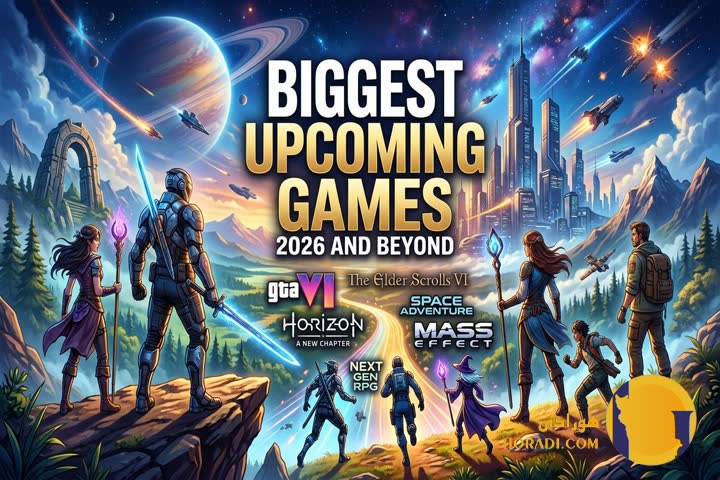
Biggest Upcoming Games of 2026 and Beyond

The global gaming industry is entering a new inflection point driven by next-gen hardware, AI-assisted development, and expansive live-service ecosystems. Studios are now building experiences that blur the line between cinematic storytelling and persistent virtual worlds.
As we move deeper into 2026 and beyond, major publishers are focusing on fewer but larger titles, emphasizing long-term engagement, cross-platform ecosystems, and scalable content pipelines powered by modern engines like Unreal Engine 5.
Expect a wave of ambitious releases that redefine genres, extend franchise universes, and introduce entirely new gameplay paradigms. From open-world epics to immersive VR ecosystems, the pipeline is stacked. Gaming News
Key Takeaways
- 2026+ gaming is driven by next-gen hardware and AI-assisted development
- Major franchises are prioritizing large-scale, long-life games
- Open-world and RPG genres continue to dominate release pipelines
- VR and live-service ecosystems are rapidly expanding
- Studios are focusing on quality over quantity with massive production budgets
The 2026 Gaming Landscape Overview
The 2026 gaming ecosystem is defined by consolidation among major AAA publishers and explosive growth in development complexity. Studios are now leveraging cloud infrastructure and AI tools to accelerate production cycles.
Industry analysts from Bloomberg Gaming and IGN highlight a shift toward fewer but larger flagship releases. This trend reflects rising development costs and audience demand for long-term replayable content.
Cross-platform ecosystems are now standard for major releases. Players expect seamless progression across console, PC, and cloud services.
The definition of a “game release” is evolving into ongoing content platforms. This shift reshapes monetization, engagement, and storytelling structures across the industry.
Grand Theft Auto VI and Open-World Evolution
Open-world design continues to be led by franchises like Rockstar Games’ Grand Theft Auto VI. The game represents a benchmark for environmental density and simulation fidelity.
Expect dynamic NPC systems, evolving city ecosystems, and deeply reactive narratives. These systems push CPU and AI simulation boundaries beyond previous generations.
The open-world genre is transitioning from static maps to living digital societies. This evolution is heavily documented by GameSpot and IGN coverage.
Future updates and expansions are expected to turn these titles into decade-long platforms. This mirrors the growing “games as ecosystems” philosophy dominating AAA design.
PlayStation Exclusives Shaping 2026
Sony’s first-party strategy continues focusing on narrative-driven, cinematic experiences. Franchises like Horizon, God of War, and new IPs remain central pillars.
The PlayStation ecosystem is optimizing for PS5 Pro-era enhancements. This includes ray tracing upgrades and advanced spatial audio systems.
Developers are increasingly leveraging proprietary engines tuned for immersion. This allows tighter storytelling and more controlled gameplay pacing.
According to The Game Awards ecosystem previews, Sony remains focused on prestige titles. These releases aim to maintain strong critical and commercial balance.
Xbox and Game Pass Future Lineup
Microsoft’s Xbox strategy in 2026 revolves around subscription-first gaming via Game Pass. This model prioritizes accessibility and day-one availability for major titles.
Studios under Xbox Game Studios and Bethesda continue expanding shared universes. These include RPG-heavy franchises and online multiplayer ecosystems.
Cloud gaming is becoming a core delivery mechanism rather than a secondary feature. This reduces hardware dependency and expands global reach.
Industry reporting from Bloomberg emphasizes Xbox’s long-term content pipeline stability. This positions the platform as a service-driven entertainment hub.
PC Gaming and Unreal Engine 5 Breakthroughs
PC gaming remains the innovation leader due to hardware flexibility and modding ecosystems. Unreal Engine 5 continues to redefine graphical fidelity and world-building scale.
Nanite and Lumen technologies are now standard in high-end PC releases. These systems drastically reduce performance bottlenecks in large environments.
Developers are using PC as a testing ground for cross-platform optimization. This ensures smoother console adaptation later in the pipeline.
According to IGN technical breakdowns, PC remains the benchmark platform. It consistently pushes visual and performance ceilings forward.
Next-Gen RPGs to Watch
RPGs remain one of the most dominant genres heading into 2026 and beyond. Expansive narrative systems and branching dialogue trees are becoming more sophisticated.
Modern RPGs now integrate AI-driven NPC behavior and adaptive storytelling systems. This creates unique experiences for each player session.
Franchises like Elder Scrolls, Dragon Age, and new IPs lead this category. Each focuses on scale, immersion, and player agency.
The RPG genre continues merging with open-world design philosophies. This hybrid model defines the future of long-form interactive storytelling.
Sci-Fi and Space Exploration Titles
Sci-fi gaming is experiencing a resurgence driven by procedural generation systems. Developers are building massive explorable galaxies with persistent ecosystems.
Space exploration mechanics now emphasize realism and simulation depth. Fuel systems, physics modeling, and interplanetary travel are increasingly complex.
Studios are combining narrative-driven quests with sandbox exploration freedom. This creates hybrid gameplay structures that appeal to diverse audiences.
Coverage from GameSpot highlights rising investment in sci-fi IPs. These projects often serve as long-term franchise foundations.
Multiplayer and Live-Service Blockbusters
Live-service games continue dominating revenue models across the industry. These titles rely on seasonal content, battle passes, and community-driven updates.
Multiplayer ecosystems are increasingly platform-agnostic and cross-play enabled. This expands matchmaking pools and improves long-term retention.
Developers are focusing on balancing monetization with player satisfaction. Poorly designed economies are now heavily penalized by communities.
According to IGN esports and multiplayer coverage, sustainability is key. Only well-supported ecosystems survive beyond initial launch cycles.
Indie Games Breaking Into AAA Space
Indie developers are closing the gap with AAA studios through advanced tools. Unreal Engine accessibility and funding platforms are driving innovation.
Many indie titles now feature production quality previously reserved for AAA releases. This includes cinematic storytelling and advanced physics systems.
Publishers are increasingly acquiring standout indie studios early. This integrates creative innovation into larger production pipelines.
Industry reports show indie success is reshaping creative risk-taking. Smaller teams now influence mainstream design trends significantly.
VR and Immersive Gaming in 2026+
Virtual reality gaming is transitioning from novelty to mainstream platform segment. Hardware improvements are reducing latency and improving visual fidelity.
Full-body tracking and haptic feedback systems are becoming more common. This enhances immersion and physical interaction within digital worlds.
Developers are building VR-native experiences instead of adapting flat-screen games. This results in more intuitive and engaging gameplay loops.
Analysts from Bloomberg Technology predict steady VR adoption growth. The ecosystem is still emerging but rapidly stabilizing.
Sources & Industry Credibility
Key insights are supported by leading industry authorities tracking gaming evolution. These sources provide consistent coverage of AAA development trends.
IGN regularly publishes technical breakdowns and release forecasts. Their reporting is widely used for industry benchmarking.
GameSpot offers deep analysis of genre trends and franchise evolution. Their editorial coverage tracks long-term gaming shifts.
Bloomberg Gaming & Technology provides financial and industry-level reporting. This includes publisher strategy, investment flows, and market forecasting.
Final Verdict
The biggest upcoming games of 2026 and beyond signal a clear industry transformation. Games are evolving into persistent, high-fidelity digital ecosystems.
Franchises are scaling larger, but also becoming more service-oriented and long-lasting. This shift prioritizes engagement depth over traditional release cycles.
Players can expect fewer but significantly more ambitious releases. The future of gaming is defined by immersion, scale, and continuous evolution.
FAQ
What are the most anticipated games of 2026?
Major expected titles include next entries in open-world, RPG, and live-service franchises. These are driven by AAA publishers focusing on long-term ecosystem games.
Will GTA VI change open-world gaming?
Yes, it is expected to push simulation density and AI-driven world systems. It may redefine standards for open-world design for years.
Are RPGs still popular in 2026?
RPGs remain one of the strongest genres globally. They now integrate AI-driven storytelling and expanded world systems.
Is VR gaming finally becoming mainstream?
VR adoption is growing steadily with improved hardware and content. However, it is still transitioning toward mass-market saturation.
What is the biggest trend in gaming beyond 2026?
The dominant trend is persistent live-service ecosystems. Games are increasingly treated as evolving platforms rather than products.