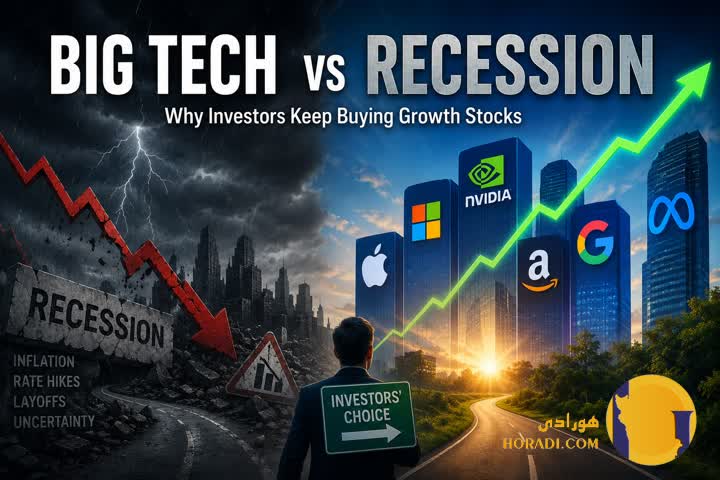
Big Tech vs Recession Why Investors Keep Buying Growth Stocks

Markets in 2026 are still carrying a familiar contradiction recession warnings on one side, and relentless buying of growth stocks on the other. Big Tech sits right at the center of that tension.
Despite tighter monetary conditions over the past cycles and uneven global demand, capital continues flowing into companies shaping AI, cloud infrastructure, and digital platforms. The logic is not emotional—it is structural.
Institutional investors increasingly treat Big Tech as “recession-resistant growth,” not because it is immune to downturns, but because its earnings power scales differently than traditional cyclicals. Market News
Key Takeaways
- Big Tech earnings remain structurally stronger than most sectors
- AI infrastructure is reshaping long-term growth expectations
- Investors prioritize cash flow stability over short-term macro noise
- Institutional capital continues to concentrate in mega-cap tech
- Valuations are supported by productivity and platform dominance
The Market Paradox Growth Stocks in a Recession Narrative
Markets often behave in ways that defy textbook economics, and 2026 is no exception. While recession fears persist across global indicators, equity flows continue to favor growth-heavy indices.
The S&P 500’s weighting toward mega-cap technology distorts traditional recession signals. Investors are effectively betting on a narrow set of companies to carry broader index performance.
This creates a structural divergence between macro data and equity pricing behavior. The disconnect is not irrational—it reflects where profits are actually being generated.
Why Big Tech Defies Traditional Cyclical Pressure
Unlike industrials or consumer discretionary firms, Big Tech operates on recurring revenue models that stabilize cash flow. Subscription ecosystems and cloud contracts reduce volatility.
Companies such as Microsoft Corporation and Amazon.com Inc. have diversified income streams that behave more like utilities than traditional tech.
Even during demand slowdowns, enterprise software spending tends to adjust rather than collapse, creating a soft landing effect on earnings.
Interest Rates and the New Investment Lens
Higher-for-longer interest rate expectations have reshaped valuation models, but they have not reduced appetite for dominant growth franchises. Instead, investors have become more selective.
According to the Federal Reserve’s 2026 financial stability assessments, capital concentration in high-quality equities has increased as investors avoid speculative segments.
Lower discount-rate sensitivity in companies with strong free cash flow helps explain why Big Tech continues to attract institutional capital.
AI Infrastructure The Core Growth Engine
Artificial intelligence has become the defining investment theme of the decade. It is no longer speculative—it is infrastructural.
Alphabet Inc. and other hyperscalers are scaling AI compute clusters at unprecedented levels, reshaping capital expenditure cycles across the sector.
Bloomberg Intelligence estimates that global AI infrastructure spending will exceed $400B annually by late 2026, reinforcing long-term growth visibility.
Earnings Power and Margin Expansion
Big Tech margins remain structurally higher than most sectors due to scale advantages and software-driven efficiency. This is critical during macro uncertainty.
Unlike labor-heavy industries, digital platforms scale without proportional cost increases, leading to expanding operating leverage.
Goldman Sachs research notes that margin resilience is a key driver behind continued institutional overweight positions in technology equities.
Consumer Demand Stability in Digital Ecosystems
Even during periods of reduced discretionary spending, digital ecosystems maintain engagement. People may cut physical goods, but not digital infrastructure.
Platforms tied to communication, productivity, and entertainment show minimal churn compared to cyclical sectors.
This behavioral stability supports recurring revenue models, especially for firms embedded in daily workflows and enterprise systems.
Institutional Capital Flows and ETF Concentration
One of the most underappreciated forces in 2026 markets is passive capital concentration. ETFs continue to funnel inflows into the largest weighted names.
This creates a self-reinforcing loop where mega-cap stocks receive incremental demand regardless of macro sentiment.
Pension funds and sovereign wealth allocations further stabilize Big Tech valuations through long-term positioning.
Valuation Reset Cycles and Investor Psychology
Valuations in Big Tech are no longer judged solely on P/E ratios. Investors increasingly focus on long-term cash flow durability and platform dominance.
During past downturns, such as 2022’s tech correction, pricing resets created entry points that reinforced long-term bullish sentiment.
Psychologically, investors now view dips as structural buying opportunities rather than warning signals.
Risk Factors Hidden Beneath the Optimism
Despite strong narratives, risks remain embedded in the sector. Regulatory pressure, especially in the EU and US, continues to evolve.
Cloud competition and AI commoditization could compress margins over time, particularly if open-source models scale faster than expected.
Even Federal Reserve commentary highlights the risk of asset concentration creating systemic sensitivity to a handful of equities.
The Role of Mega-Cap Dominance in Index Performance
Index performance is increasingly dictated by a small group of companies. This changes how investors interpret “market health.”
When a few firms drive returns, traditional diversification strategies lose effectiveness in explaining index behavior.
As a result, Big Tech effectively sets the tone for broader equity sentiment, especially in recession-sensitive environments.
Global Capital Rotation Toward Digital Assets
International capital is increasingly rotating away from low-growth regions into US technology leadership. This trend has accelerated in 2026.
Emerging markets face structural challenges, while US-based platforms continue to dominate digital infrastructure.
The result is a persistent bid for growth equities regardless of cyclical uncertainty.
Final Verdict Why Growth Still Wins the Narrative
Big Tech’s resilience is not about immunity to recession—it is about structural dominance in a digital-first economy.
As long as AI expansion, cloud adoption, and platform economics continue scaling, growth stocks will remain central to investor strategy even in uncertain macro cycles.
The market is not ignoring risk; it is pricing in durability.
FAQ
1. Why do investors prefer Big Tech during recessions?
Because of strong cash flows, recurring revenue models, and global scale advantages.
2. Is Big Tech actually recession-proof?
No, but it is more resilient than cyclical sectors due to diversified revenue streams.
3. How does AI impact Big Tech growth in 2026?
AI drives massive infrastructure spending and long-term productivity gains.
4. Are Big Tech valuations too high?
Valuations reflect future cash flow expectations rather than short-term earnings alone.
5. What risks could slow down growth stocks?
Regulation, margin compression, and macro shocks remain key risks.