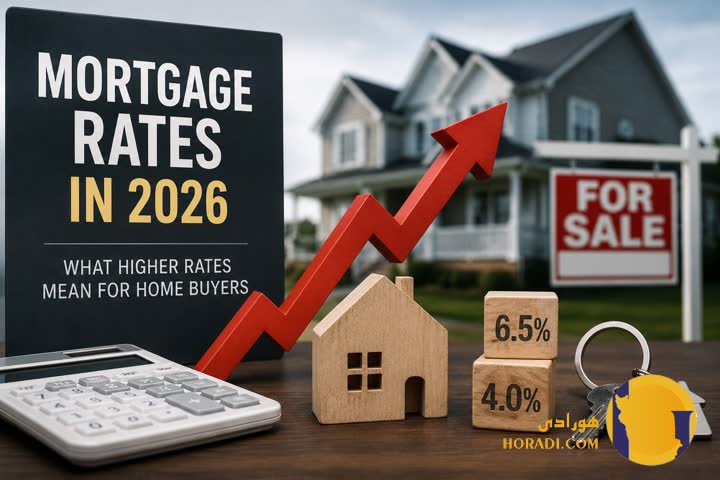
Mortgage Rates in 2026 What Higher Rates Mean for Home Buyers

The US housing market in 2026 is operating under a different set of rules than the ultra-low-rate era many buyers remember. Mortgage rates remain a major factor shaping affordability, influencing monthly payments, buyer confidence, and home prices. For millions of Americans, the question is no longer just “Can I buy a home?” but “Can I comfortably afford one?”
Higher borrowing costs have changed the way buyers approach real estate decisions. A small percentage-point increase in mortgage rates can add hundreds of dollars to monthly payments over a 30-year loan. That difference affects everything from neighborhood choices to down payment strategies.
The Federal Reserve’s interest rate policy, inflation trends, and bond market movements continue to influence mortgage pricing. While mortgage rates do not directly follow the Federal Funds Rate, they often react to expectations about future economic conditions. Buyers in 2026 must understand these connections before entering the market. Market News
Key Takeaways
- Mortgage rates in 2026 remain one of the biggest affordability challenges for US home buyers.
- Higher rates increase monthly payments and reduce purchasing power.
- Buyers are using larger down payments, adjustable-rate mortgages, and negotiation strategies to manage costs.
- Home prices may experience slower growth as affordability pressures limit demand.
- Economic indicators, including inflation and Federal Reserve policy, will remain critical drivers of mortgage trends.
Why Mortgage Rates Are Higher in 2026
Mortgage rates are primarily influenced by the yield on the 10-year US Treasury bond, investor expectations, inflation, and economic growth. Although the Federal Reserve controls short-term interest rates, mortgage lenders price loans based on longer-term market conditions. This distinction explains why mortgage rates can move differently from Fed policy announcements.
In 2026, lenders continue balancing inflation concerns with expectations of economic stability. When investors demand higher returns from government bonds, mortgage rates usually rise as well. Banks must price loans competitively while protecting themselves against long-term financial risks.
Several economic factors contribute to elevated mortgage rates
| Factor | Impact on Mortgage Rates |
|---|---|
| Inflation expectations | Higher inflation can push rates upward |
| Treasury yields | Rising yields typically increase mortgage costs |
| Federal Reserve policy | Influences market confidence |
| Housing demand | Affects lender competition |
The current environment represents a return to more historically normal borrowing conditions. Many buyers who entered the market after 2010 became accustomed to unusually cheap mortgages. The 2026 market requires a different financial mindset focused on long-term affordability rather than chasing low rates.
How Higher Mortgage Rates Affect Monthly Payments
The biggest immediate impact of higher mortgage rates is the increase in monthly housing expenses. A difference of even 1% in interest rates can significantly change the total cost of a home loan. For first-time buyers, this calculation often determines whether a purchase is realistic.
Consider a $400,000 mortgage with a 30-year fixed loan. At a lower rate, the payment may fit comfortably within a household budget. At a higher rate, the same home could require thousands more annually in interest costs.
| Loan Amount | Rate Difference | Long-Term Impact |
|---|---|---|
| $400,000 | +1% | Thousands more in interest |
| $500,000 | +1% | Larger monthly payment increase |
| $600,000 | +1% | Significant affordability pressure |
Higher payments also affect other financial goals. Buyers may have less money available for retirement savings, emergency funds, renovations, or family expenses. Financial experts increasingly recommend evaluating the complete ownership cost instead of focusing only on the mortgage approval amount.
What Higher Rates Mean for Home Affordability
Affordability has become one of the defining issues in the 2026 housing market. Even if home prices stabilize, expensive financing can keep ownership out of reach for many households. The combination of elevated prices and higher rates creates a difficult environment for new buyers.
A buyer approved for a $500,000 mortgage several years ago may qualify for significantly less today. Lenders calculate debt-to-income ratios carefully, meaning higher interest costs reduce borrowing capacity. This forces many buyers to reconsider locations, property sizes, or timing.
Common affordability adjustments include
- Choosing smaller homes or different neighborhoods.
- Increasing down payments.
- Considering longer search periods.
- Negotiating more aggressively with sellers.
The challenge is particularly noticeable among younger buyers entering the market. Many millennials and Generation Z buyers are balancing student loans, rising living expenses, and limited housing inventory. Higher mortgage rates add another layer of complexity to building long-term wealth through homeownership.
Are Home Prices Falling Because of Higher Mortgage Rates?
Higher mortgage rates do not automatically cause a housing crash. Instead, they usually slow market activity by reducing the number of qualified buyers. The relationship between rates and prices depends on supply, demand, employment conditions, and regional market trends.
In some areas, sellers may lower asking prices because fewer buyers can afford their properties. In competitive markets with limited inventory, prices may remain relatively strong despite expensive financing. Housing markets across the US continue to show significant regional differences.
Economists often describe the current environment as a “lock-in effect.” Millions of homeowners with older low-rate mortgages are reluctant to sell because moving would mean accepting much higher borrowing costs. That reduces available inventory and can support home prices.
The 2026 housing market is therefore more complicated than a simple rate-versus-price relationship. Buyers should analyze local conditions rather than relying only on national headlines. A buyer’s opportunity may depend more on a specific city or neighborhood than overall market statistics.
Strategies Home Buyers Can Use in a High-Rate Market
Buying a home in 2026 requires more preparation than during periods of historically low rates. Successful buyers are approaching the process with stronger financial planning and realistic expectations. A carefully designed strategy can reduce the impact of higher borrowing costs.
One option is increasing the down payment amount. A larger upfront payment lowers the loan balance and may reduce monthly expenses. It can also make offers more attractive in competitive markets.
Other strategies include
- Comparing multiple mortgage lenders.
- Negotiating seller concessions.
- Improving credit scores before applying.
- Exploring different loan products.
Some buyers are also considering adjustable-rate mortgages (ARMs) when appropriate. These loans can offer lower initial payments, but they carry future rate-change risks. Borrowers should understand the terms fully rather than choosing a loan based only on the starting payment.
Fixed-Rate Mortgages vs Adjustable-Rate Mortgages in 2026
The choice between a fixed-rate mortgage and an adjustable-rate mortgage depends on personal circumstances. A fixed-rate mortgage provides predictable payments throughout the loan term. That stability remains attractive for buyers who plan to stay in their homes for many years.
Adjustable-rate mortgages may appeal to buyers expecting to move before the adjustment period begins. For example, a professional relocating for work within five years may value a lower initial payment. The strategy becomes riskier for buyers planning permanent ownership.
| Mortgage Type | Advantages | Risks |
|---|---|---|
| Fixed-rate mortgage | Payment stability | Higher initial rates |
| Adjustable-rate mortgage | Lower starting costs | Future payment increases |
Mortgage experts emphasize that there is no universally “best” loan type. The right choice depends on income stability, future plans, and personal risk tolerance. A buyer’s financial profile matters more than general market predictions.
How First-Time Buyers Are Adapting to 2026 Mortgage Conditions
First-time buyers face some of the toughest conditions in the current housing market. Many are entering with limited savings while competing against existing homeowners with significant equity. Higher mortgage rates make preparation more important than ever.
Many first-time buyers are changing their approach by expanding search areas. Moving slightly farther from major employment centers can create more affordable opportunities. Others are exploring assistance programs designed to reduce upfront costs.
Important preparation steps include
- Building a stronger credit profile.
- Saving beyond the minimum down payment.
- Understanding closing costs.
- Getting pre-approved before shopping.
Despite challenges, homeownership remains a major financial goal for many Americans. The key difference in 2026 is that buyers must be more strategic. Waiting for perfect conditions may not always work because market conditions can change unpredictably.
The Role of the Federal Reserve in Mortgage Rate Trends
The Federal Reserve plays an important role in financial markets, but it does not directly set mortgage rates. Instead, Fed decisions influence investor expectations about inflation, economic growth, and future interest rates. Mortgage markets often react before official policy changes occur.
When the Fed signals confidence that inflation is slowing, bond markets may respond positively. That can create downward pressure on mortgage rates over time. If inflation remains persistent, lenders may continue charging higher rates.
The Federal Reserve monitors several economic indicators
| Indicator | Why It Matters |
|---|---|
| Inflation data | Measures price stability |
| Employment reports | Shows economic strength |
| Consumer spending | Reflects demand trends |
Buyers should avoid making decisions based on a single Fed announcement. Mortgage markets move based on broader economic expectations. Understanding these trends helps buyers make better timing decisions.
Mortgage Rate Predictions and Housing Market Outlook for 2026
Forecasting mortgage rates is challenging because financial markets respond to unexpected events. Economic growth, inflation surprises, global conflicts, and government policy can quickly change expectations. Experts generally focus on trends rather than exact predictions.
Many analysts expect mortgage rates to remain above the extremely low levels seen during the pandemic period. A return to historically unusual rates is unlikely unless major economic conditions change. Buyers should plan around realistic financing costs.
The 2026 housing outlook will likely depend on
- Inflation progress.
- Labor market strength.
- Housing inventory levels.
- Consumer confidence.
For buyers, waiting for dramatically lower rates may involve risks. If rates decline but demand rises sharply, competition and home prices could increase. The best decision depends on personal financial readiness rather than trying to perfectly predict the market.
How Existing Homeowners Are Affected by Higher Mortgage Rates
Higher rates influence current homeowners as well as potential buyers. Many homeowners who secured low mortgage rates years ago are choosing to stay in place. This reduces the number of homes available for sale in many markets.
Refinancing activity has also changed dramatically compared with previous years. When mortgage rates are higher than existing loan rates, refinancing becomes less attractive. Many homeowners prefer keeping their current financing arrangements.
Homeowners considering selling should evaluate
- Current mortgage balance.
- Expected replacement housing costs.
- Local buyer demand.
- Future financial goals.
The rate environment creates a unique divide between homeowners and buyers. Existing owners with low-rate mortgages often have financial advantages. New buyers must rely more heavily on planning, savings, and careful decision-making.
Expert Sources and Market Data Behind 2026 Mortgage Trends
Reliable mortgage information comes from organizations that track housing finance, economic conditions, and lending activity. Home buyers should prioritize data from established institutions rather than social media predictions. Accurate information is essential when making one of the largest financial decisions of a lifetime.
Key sources include
- Federal Reserve — Provides economic policy information and interest rate data.
- Freddie Mac — Tracks mortgage market trends through its Primary Mortgage Market Survey.
- National Association of Realtors (NAR) — Publishes housing market research and affordability reports.
These organizations provide valuable insight into mortgage rates, housing inventory, and buyer behavior. Their research helps consumers understand broader market conditions. Individual circumstances, including income and location, remain equally important.
Final Verdict Should You Buy a Home With Higher Mortgage Rates in 2026?
Higher mortgage rates have changed the economics of buying a home, but they have not eliminated opportunities. The strongest buyers in 2026 are those who focus on affordability, financial preparation, and long-term goals. A home purchase should fit a budget today, not only depend on hopes for future refinancing.
Waiting for lower rates may make sense for some buyers, while others may benefit from purchasing now and adjusting later. The decision depends on income stability, local housing conditions, and personal priorities. There is no universal answer for every household.
The 2026 housing market rewards patience, research, and realistic expectations. Buyers who understand mortgage costs and prepare carefully can still make smart decisions. Higher rates create challenges, but informed planning creates opportunities.
FAQ Mortgage Rates in 2026
What are mortgage rates expected to be in 2026?
Mortgage rates in 2026 are expected to remain influenced by inflation, Treasury yields, and Federal Reserve policy. Experts generally do not expect a return to pandemic-era rates without major economic changes.
Are higher mortgage rates causing home prices to fall?
Higher mortgage rates can reduce buyer demand and slow price growth. However, limited housing inventory in many areas may prevent significant price declines.
Should I wait to buy a house until mortgage rates drop?
Waiting depends on personal finances and market conditions. Lower rates could improve affordability, but increased demand may also push home prices higher.
How can I lower my mortgage payment in 2026?
Buyers can reduce payments by increasing their down payment, improving credit scores, comparing lenders, and negotiating seller concessions.
Is an adjustable-rate mortgage a good option in 2026?
An adjustable-rate mortgage may work for buyers with specific plans and shorter ownership periods. Borrowers should carefully evaluate future payment risks before choosing this option.