
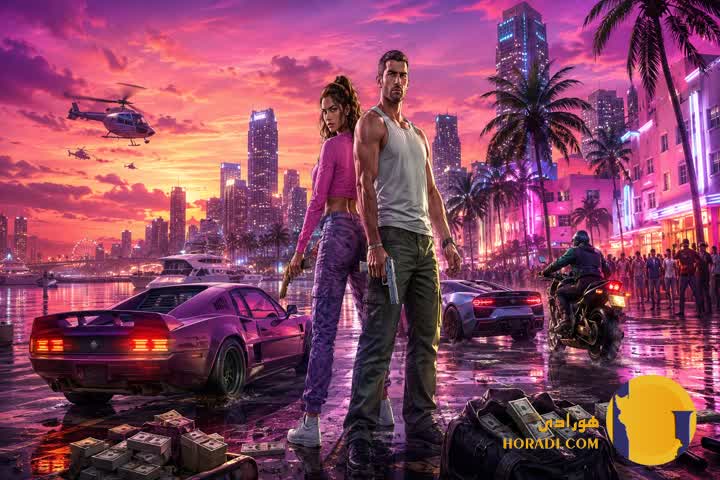
Grand Theft Auto VI Everything We Know So Far in 2026

Grand Theft Auto VI remains one of the most analyzed entertainment releases in modern gaming history. Even in 2026, the anticipation has not cooled down among players or investors tracking Take-Two Interactive. Rockstar Games has maintained a controlled silence that only fuels speculation and market momentum.
The franchise has always reshaped expectations for open-world design and narrative scale. From GTA III to GTA V, each release reset technical and cultural benchmarks in gaming. GTA VI is expected to continue that pattern under significantly higher production pressure.
What makes this title different is the industry context surrounding it today. We are in an era of AI-driven game development, live-service dominance, and massive production budgets. That combination puts GTA VI under a spotlight no previous Rockstar title has experienced.
Leaks, financial reports, and official teasers have slowly shaped the current understanding. Still, Rockstar continues to withhold full details, preserving its traditional marketing strategy. That silence has turned GTA VI into a long-cycle economic and cultural event. Game News
Key Takeaways
- GTA VI remains the most anticipated AAA release in 2026
- Rockstar Games continues strict information control strategy
- Industry expectations are shaped by AI and next-gen console capabilities
- Take-Two Interactive investor pressure is unusually high
- Open-world standards are expected to be redefined again
Development Timeline How GTA VI Became a Decade-Defining Project
The development cycle of GTA VI is widely considered one of the longest in Rockstar history. Production reportedly scaled up significantly after GTA V Online became a financial powerhouse. This shifted priorities toward long-term ecosystem planning rather than fast release cycles.
Internal restructuring at Rockstar Games also influenced pacing and direction. Teams were redistributed across global studios to support larger asset pipelines. This allowed more detailed world-building but extended production timelines considerably.
Industry reports, including coverage from Bloomberg’s Jason Schreier, suggest early builds evolved over years. Design philosophies were repeatedly revised to align with new hardware expectations. This iterative approach reflects Rockstar’s risk-averse but quality-focused development model.
Take-Two Interactive’s earnings calls consistently reaffirmed extended development investment. Executives emphasized “long-term value creation” over strict release scheduling. That corporate strategy effectively gave Rockstar more freedom to delay without market collapse.
Rockstar’s Vision Reinventing Open-World Immersion at Scale
Rockstar Games is pursuing a more systemic open-world simulation model in GTA VI. Rather than expanding size alone, the focus is on behavioral depth and environmental response. This reflects broader industry movement toward living-world game design.
NPC systems are expected to be significantly more dynamic than GTA V’s framework. Reported improvements include persistent memory behaviors and adaptive crowd logic. These upgrades aim to reduce predictability in mission and free-roam interactions.
Environmental storytelling is also being redesigned at micro and macro levels. Small-world events may evolve independently of player presence or mission triggers. This creates a simulation layer closer to emergent sandbox ecosystems.
Industry analysts from IGN and Digital Foundry have highlighted Rockstar’s technical ambition. They consistently point to GTA VI as a benchmark test for next-gen CPU workloads. The expectation is not just visual fidelity, but systemic realism under load.
Map and Setting Vice City Returns With a Modern Expansion Model
GTA VI is widely confirmed to return to a modernized Vice City-inspired setting. However, this version expands far beyond the original compact urban structure. It includes surrounding regions that resemble a full-state simulation design.
The map is expected to feature dense urban cores, rural zones, and coastal ecosystems. This diversification supports multiple gameplay styles and mission architectures. It also aligns with Rockstar’s trend toward geographic storytelling.
Transportation systems appear to play a larger role in world traversal. Air, sea, and highway networks are reportedly more integrated than GTA V. This improves realism and supports longer mission chains across regions.
| Region Type | Design Focus | Gameplay Impact |
|---|---|---|
| Urban City | Dense NPC systems | High interaction density |
| Rural Areas | Exploration & survival | Lower police density |
| Coastal Zones | Smuggling & trade routes | Dynamic mission paths |
Gameplay Mechanics Smarter Systems and Reduced Predictability
Gameplay in GTA VI is expected to shift toward adaptive systems rather than scripted loops. This reduces repetitive mission structures that defined earlier Rockstar titles. It also increases replay variability significantly.
Combat systems are rumored to include improved cover mechanics and physics-based recoil. Enemy AI is designed to react to environmental changes rather than fixed patterns. This creates more organic firefights and tactical decision-making.
Driving mechanics are also undergoing refinement for realism and weight distribution. Vehicle handling reportedly varies more significantly across terrain types. This supports deeper immersion in rural and urban transitions.
Player choice systems may carry longer-term consequences across missions. This includes faction reputation systems and persistent world state changes. Such design moves GTA closer to RPG-like structural depth.
Story and Characters Dual Protagonists and Modern Crime Narratives
GTA VI is expected to continue the dual-protagonist structure introduced in GTA V. Early reports suggest a male and female lead dynamic inspired by modern crime duos. This allows narrative flexibility across contrasting perspectives.
The storyline is believed to center around evolving criminal economies. Themes include digital crime, smuggling networks, and decentralized operations. This reflects real-world shifts in illicit global trade patterns.
Character development is expected to be more emotionally grounded than previous entries. Rockstar appears to be focusing on relationship-driven narrative arcs. This supports deeper engagement over longer play cycles.
Mission design may integrate story progression more fluidly into open-world events. Instead of linear chapters, progression could emerge through world interaction. This represents a major structural shift in Rockstar storytelling philosophy.
Graphics and Engine Pushing the RAGE Engine to Its Limits
GTA VI is built on an advanced iteration of Rockstar’s RAGE engine. This version emphasizes global illumination, real-time weather simulation, and volumetric detail. It is designed specifically for current-gen hardware scalability.
Lighting systems are expected to be a major visual leap over GTA V. Dynamic time-of-day transitions influence both gameplay and NPC behavior. This improves realism and environmental consistency.
Water physics and coastal rendering have reportedly received major upgrades. Given Vice City’s geography, ocean systems play a central visual role. This also supports new mission types involving maritime environments.
Digital Foundry analysis highlights GTA VI as a stress test for GPU architectures. Ray tracing implementation is expected to be deeply integrated, not optional. This places it among the most technically demanding games in development.
GTA Online Evolution Preparing for the Next-Generation Multiplayer Ecosystem
GTA Online remains one of the most profitable live-service ecosystems in gaming history. Its successor model is expected to integrate directly with GTA VI’s world structure. This creates a seamless single-player and multiplayer transition layer.
Rockstar is likely to expand persistent world systems in online mode. Player-driven economies may become more complex and decentralized. This supports longer engagement cycles and monetization stability.
Server infrastructure upgrades are also expected to reduce session fragmentation. This allows more players per instance with stable synchronization. It improves large-scale event capabilities significantly.
Community-driven content may play a larger role in long-term updates. This aligns with broader industry trends toward user-generated ecosystems. However, Rockstar will likely maintain strict content moderation control.
Release Platforms and Performance Expectations
GTA VI is expected to target current-generation consoles primarily. PlayStation 5 and Xbox Series X remain the core performance baseline. PC release timing continues to be a subject of industry debate.
Performance optimization is a key challenge given simulation complexity. Rockstar is prioritizing stable frame rates over extreme resolution scaling. This reflects lessons learned from GTA V and Red Dead Redemption 2.
Cloud streaming compatibility is also increasingly relevant in 2026. Some analysts expect partial integration with hybrid streaming models. This would expand accessibility without compromising core performance.
Hardware requirements on PC are expected to be significantly higher than average AAA titles. This includes CPU-heavy simulation and GPU-intensive rendering pipelines. Mid-range systems may require adaptive scaling to maintain stability.
Market Impact Why GTA VI Is a Financial Event, Not Just a Game
GTA VI is projected to be one of the largest entertainment launches in history. Analysts compare its release impact to blockbuster film and tech product cycles combined. Take-Two Interactive’s valuation is heavily influenced by its performance expectations.
Pre-launch hype has already influenced hardware and retail forecasting cycles. Console adoption rates often spike ahead of major Rockstar releases. This creates indirect economic effects across the gaming supply chain.
Subscription services and cloud platforms are also factoring GTA VI demand. This could shift how AAA titles are distributed in the long term. It represents a structural change in gaming economics.
Investor attention remains unusually high compared to other game franchises. This makes GTA VI a hybrid cultural and financial asset class event. Its launch will likely affect quarterly earnings across multiple sectors.
Industry Sources and Analysis What the Most Credible Reports Indicate
Multiple high-authority sources have shaped the public understanding of GTA VI. These include consistent reporting and financial disclosures rather than speculation. The most referenced outlets include Bloomberg, IGN, and Take-Two Interactive filings.
Bloomberg’s Jason Schreier has provided detailed historical reporting on development cycles. His coverage remains one of the most cited sources in industry analysis. It is widely regarded as highly reliable for Rockstar-related insights.
IGN continues to track official updates, trailers, and technical breakdowns. Their analysis focuses on gameplay systems and industry positioning. They provide consistent coverage aligned with official releases.
Take-Two Interactive’s investor reports confirm long-term investment strategy. These filings offer the most authoritative financial context available. They validate the scale and duration of GTA VI development.
Final Verdict GTA VI as the Defining Entertainment Launch of the Decade
Grand Theft Auto VI is positioned as more than a sequel in a franchise. It represents a convergence of technology, storytelling, and global entertainment economics. Few releases carry this level of cross-industry influence.
Rockstar Games is clearly prioritizing long-term ecosystem design over rapid delivery. This approach increases anticipation but also raises expectations significantly. Failure to meet them would have measurable industry consequences.
From a technical standpoint, GTA VI is expected to set new benchmarks. From a commercial standpoint, it is already a financial milestone in motion. Both realities make it one of the most important releases of the decade. Grand Theft Auto VI Everything We Know So Far in 2026
FAQ Grand Theft Auto VI (2026)
1. When is GTA VI expected to release? Industry forecasts suggest a late-cycle 2026–2027 window depending on platform readiness.
2. What city is GTA VI based on? The game is set in a modernized Vice City-inspired region with expanded surrounding areas.
3. Will GTA VI launch on PC at the same time? Current patterns suggest a staggered PC release following console launch.
4. What engine is GTA VI using? It uses an advanced version of Rockstar’s RAGE engine with major graphical upgrades.
5. Will GTA Online continue in GTA VI? Yes, a next-generation online ecosystem is expected to evolve from GTA Online.