
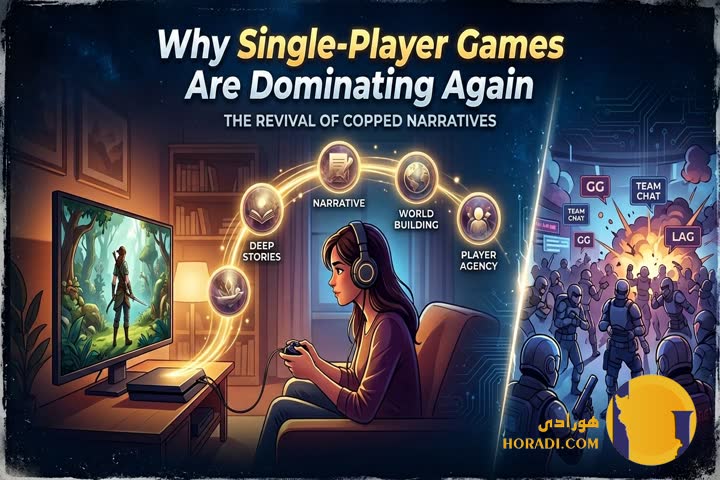
Why Single Player Games Are Dominating Again

The gaming industry is undergoing a structural shift in 2026. After years of live-service dominance, single-player games are resurging strongly. This change is reshaping development priorities across major studios.
Players are increasingly favoring curated experiences over endless monetization loops. AAA studios are responding with narrative-heavy and offline-first titles. Indie developers are also capitalizing on this renewed demand.
Industry analysts from Newzoo, the Entertainment Software Association (ESA), and Steam Hardware Survey ecosystem reports confirm this trend. Engagement metrics show higher completion rates in single-player titles. Revenue stability is also improving for premium narrative games. Gaming
Key Takeaways
- Live-service fatigue is accelerating single-player demand
- Story-driven AAA titles are outperforming expectations
- Players prefer ownership over subscription-driven ecosystems
- Indie narrative games are gaining mainstream traction
- Market data confirms sustained growth in offline gaming
The Collapse of Live-Service Fatigue
Live-service games once dominated the gaming revenue model. But player retention has become increasingly unstable over time. Monetization pressure has led to declining user satisfaction rates.
Many titles now rely heavily on battle passes and cosmetic economies. This has created a sense of repetitive engagement loops. Players report burnout from constant progression systems.
According to ESA engagement reports, long-term retention is dropping. Players are spending fewer months per live-service title. This shift is opening space for premium single-player games.
Live-service fatigue is now a primary market driver. Gamers want complete experiences rather than endless updates. This behavioral shift is reshaping studio investment strategies.
Developers are reallocating resources toward narrative depth. Fewer live-service experiments are entering production pipelines. The industry is quietly pivoting toward offline experiences.
Steam data shows higher completion rates for story-driven games. This indicates stronger emotional commitment from players. It also signals a return to traditional gaming values.
The Return of Narrative-Driven AAA Development
AAA studios are refocusing on cinematic storytelling. This shift is driven by player demand for emotional depth. Narrative immersion has become a key competitive advantage.
Games now prioritize character arcs and world-building systems. Linear and semi-linear experiences are making a comeback. This contrasts sharply with sandbox live-service models.
According to Newzoo forecasts, narrative AAA spending is rising. Publishers are increasing budgets for story-first productions. This includes higher investment in writing and motion capture.
Studios are treating single-player games as premium products. This allows for higher production value per release cycle. Quality is being prioritized over continuous content updates.
Development timelines are longer but more controlled. This reduces post-launch maintenance complexity significantly. It also improves critical reception and award potential.
Players are responding positively to polished experiences. This is reflected in strong launch-week sales performance. It reinforces the viability of premium single-player models.
Player Burnout from Constant Monetization
Modern gamers are increasingly sensitive to monetization systems. Microtransactions have become a major source of frustration. This is especially true in competitive online environments.
Pay-to-progress mechanics have reduced perceived fairness. This has created distrust in many online ecosystems. Players are now actively avoiding heavily monetized titles.
ESA consumer sentiment surveys highlight rising dissatisfaction. Monetization fatigue is one of the top reported concerns. It directly impacts long-term engagement rates.
Single-player games offer a predictable cost structure. Players pay once and receive a complete experience. This model restores trust between developers and audiences.
There are no recurring financial pressures after purchase. This simplicity is becoming a major selling point again. It also improves accessibility for broader demographics.
Developers benefit from clearer revenue forecasting. This reduces dependency on unpredictable live-service metrics. It stabilizes long-term business planning.
The Rise of Offline Gaming Experiences
Offline gaming is experiencing a measurable resurgence. Players are prioritizing accessibility and independence. Internet-free gameplay is becoming a key feature demand.
This trend is especially strong in portable and PC gaming. Steam and console ecosystems both show offline usage growth. This reflects a desire for uninterrupted gameplay sessions.
Hardware surveys indicate stable engagement without connectivity. This suggests offline-first design is gaining traction again. It is reshaping how developers approach architecture.
Single-player games excel in offline environments. They do not require server maintenance or uptime guarantees. This reduces long-term operational costs significantly.
Players appreciate the freedom of uninterrupted access. This is especially important in travel or low-connectivity regions. It broadens the global reach of games.
Offline design is now seen as a feature advantage. It enhances reliability and long-term playability. This strengthens overall user satisfaction.
Indie Developers Leading the Creative Charge
Indie studios are driving innovation in single-player design. They are less constrained by monetization expectations. This allows for more experimental storytelling approaches.
Many breakout indie hits are narrative-focused experiences. These games emphasize emotional and artistic expression. They often outperform expectations on digital storefronts.
Steam charts frequently highlight indie story-driven successes. This demonstrates strong demand for unique experiences. It also challenges AAA dominance in creativity.
Indie development cycles are shorter and more flexible. This enables faster iteration on gameplay concepts. It also reduces financial risk significantly.
Smaller teams can focus deeply on narrative cohesion. This results in highly polished single-player experiences. Players often value this craftsmanship highly.
Crowdfunding and early access models support this growth. They provide financial stability during development phases. This strengthens the indie ecosystem overall.
Subscription Fatigue and Ownership Culture
Subscription gaming models are facing growing resistance. Players are questioning long-term value propositions. Ownership is becoming a central consumer preference again.
Game libraries tied to subscriptions feel temporary. This reduces emotional investment in titles. Players prefer permanent access to purchased games.
Industry data shows declining subscription engagement rates. This trend is especially visible in casual player segments. It signals a shift back to ownership-based consumption.
Single-player games reinforce the idea of ownership. Once purchased, the experience belongs to the player. This creates stronger emotional and financial commitment.
There are no content removals or rotating libraries. This permanence increases perceived value significantly. It also enhances replayability over time.
Publishers benefit from upfront revenue clarity. This reduces dependency on subscriber retention models. It stabilizes long-term financial planning.
Hardware Advancements Supporting Single-Player Worlds
Modern hardware is enabling more immersive single-player games. Ray tracing and AI-driven rendering enhance realism. This elevates narrative presentation quality significantly.
Next-gen consoles support larger and more detailed worlds. This improves storytelling through environmental design. It creates deeper player immersion overall.
Performance benchmarks show increased graphical fidelity. This supports cinematic storytelling ambitions. It also reduces technical limitations for developers.
AI-assisted development tools are accelerating production. This includes animation, dialogue, and world-building systems. It reduces development time while increasing complexity.
Single-player games benefit most from these improvements. They rely heavily on controlled narrative environments. This ensures consistency in player experience.
Hardware and software evolution are converging. This is making single-player experiences more compelling. It strengthens their market position significantly.
The Psychology of Complete Experiences
Players increasingly prefer finished, cohesive experiences. This psychological shift favors structured storytelling. It contrasts with endless live-service engagement loops.
Completion provides a sense of accomplishment. This is more satisfying than infinite progression systems. It reinforces emotional satisfaction in gaming.
Behavioral studies show higher satisfaction in story completion. This is especially true in narrative-driven genres. It supports long-term preference for single-player games.
Single-player games offer clear beginning and end points. This structure aligns with natural cognitive reward systems. It makes experiences more memorable and impactful.
Players can revisit games without losing progression integrity. This enhances replay value over time. It strengthens attachment to game narratives.
The psychological appeal is becoming a major design focus. Developers are optimizing for emotional resonance. This is reshaping modern game design philosophy.
Economic Stability of Premium Game Pricing
Premium pricing models are regaining industry trust. Single-player games typically follow this structure. It provides predictable revenue per unit sold.
This model reduces dependency on microtransactions. It also avoids backlash associated with monetization systems. Players increasingly prefer this transparent structure.
Financial reports show strong launch sales for premium titles. This trend is consistent across multiple genres. It reinforces the viability of upfront pricing.
Publishers benefit from clearer forecasting models. They can estimate returns based on pre-launch demand. This reduces financial uncertainty significantly.
Marketing strategies are more focused and efficient. There is no need for long-term engagement campaigns. This lowers operational overhead.
Premium pricing also improves brand trust. Players associate it with higher quality experiences. This strengthens long-term franchise value.
Cross-Platform Accessibility of Single-Player Games
Modern single-player games are highly cross-platform. They are available on PC, consoles, and handheld devices. This increases accessibility across player demographics.
Cloud gaming is also expanding reach further. Players can access titles without high-end hardware. This lowers barriers to entry significantly.
Platform data shows increasing cross-play adoption. This includes save synchronization and portability features. It enhances user convenience dramatically.
Single-player experiences adapt well to multiple platforms. They do not rely on competitive synchronization systems. This simplifies technical implementation.
Developers can focus on optimization rather than server scaling. This reduces infrastructure complexity significantly. It improves performance consistency.
Cross-platform availability increases market penetration. This strengthens overall revenue potential. It supports long-term franchise growth.
The Cultural Shift Toward Focused Entertainment
Modern audiences are embracing focused entertainment formats. This includes games, films, and interactive narratives. Attention economy pressures are reshaping consumption habits.
Players prefer shorter, more meaningful engagements. Single-player games align perfectly with this trend. They provide structured and impactful experiences.
Media consumption studies support this behavioral shift. Users are increasingly avoiding fragmented content loops. This benefits narrative-driven gaming experiences.
Single-player games offer uninterrupted storytelling flow. This enhances emotional immersion and retention. It differentiates them from online multiplayer ecosystems.
Cultural trends emphasize quality over quantity. This is influencing both developers and publishers. It is reshaping long-term industry direction.
The result is a renewed appreciation for crafted experiences. This reinforces the dominance of single-player design. It signals a lasting structural change.
Final Verdict
Single-player games are not just returning temporarily. They are redefining the foundation of modern game design. This shift is driven by psychology, economics, and technology.
Live-service fatigue, monetization resistance, and narrative demand. These forces are converging to reshape the entire industry. The result is a strong, sustained single-player resurgence.
As long as players value ownership and storytelling depth. Single-player games will remain a dominant force in 2026 and beyond. This is a structural evolution, not a passing trend.
FAQ
1. Why are single-player games becoming popular again in 2026?
Because players are experiencing fatigue from live-service monetization and prefer complete, story-driven experiences.
2. Are live-service games dying out completely?
No, but their growth is slowing as player engagement shifts toward premium single-player titles.
3. What makes single-player games more appealing now?
Ownership, narrative depth, offline accessibility, and lack of aggressive monetization systems.
4. Which companies are leading the single-player revival?
Major AAA studios and indie developers, supported by platforms like Steam and console ecosystems.
5. Will single-player games dominate the future of gaming?
They are expected to remain a major pillar, especially as demand for narrative experiences continues to rise.