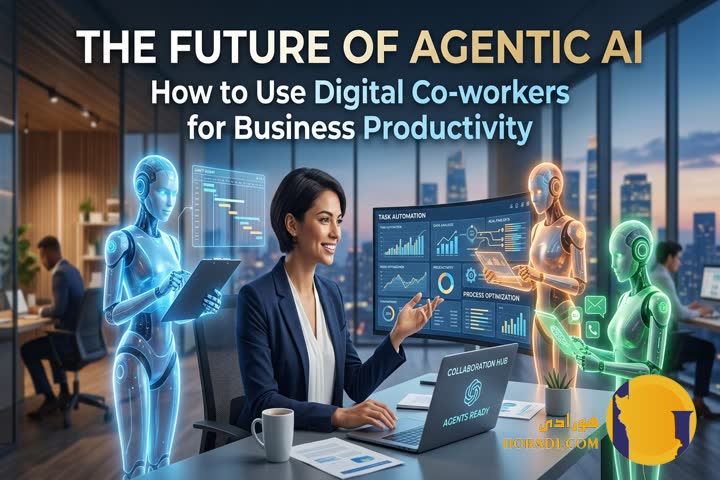
The Future of Agentic AI How to Use Digital Co-workers for Business Productivity

Agentic AI is no longer an experimental concept in enterprise labs. It is becoming a structural layer of modern business operations. Companies now deploy autonomous digital co-workers to execute complex tasks.
Unlike traditional automation, agentic systems reason, plan, and act independently. They integrate with enterprise tools, APIs, and decision pipelines at scale. This shift is redefining productivity across industries in 2026.
From finance to logistics, organizations are rethinking workforce architecture. Digital co-workers are not replacing humans but amplifying operational capacity. The result is a hybrid workforce model driven by intelligence systems. Technology Ai News
Key Takeaways
- Agentic AI enables autonomous task execution beyond traditional automation
- Digital co-workers integrate with enterprise workflows and decision systems
- Productivity gains come from orchestration, not just task automation
- Leading firms like Microsoft and NVIDIA are driving infrastructure innovation
- Risk management and governance are critical for scalable adoption
What Agentic AI Really Means in 2026
Agentic AI refers to systems that can independently plan multi-step tasks. They are capable of adapting strategies based on real-time feedback loops. This makes them fundamentally different from static rule-based automation.
In enterprise environments, these agents behave like autonomous workers. They interact with software tools, databases, and external services directly. Their goal orientation allows them to complete end-to-end workflows.
A defining feature is contextual reasoning across business environments. They maintain memory, evaluate constraints, and optimize execution paths. This enables more dynamic decision-making than traditional software.
Early frameworks from OpenAI and other research labs shaped this evolution. Modern implementations now integrate multimodal reasoning and execution. Agentic AI has become a foundational enterprise capability.
The Rise of Digital Co-Workers in Enterprises
Digital co-workers are AI agents embedded into daily business operations. They function alongside human employees in hybrid workforce systems. Their role includes execution, monitoring, and optimization of tasks.
These systems are increasingly used in finance, HR, and customer support. They reduce operational bottlenecks by handling repetitive cognitive workloads. This allows human teams to focus on strategic decision-making.
Enterprises deploy them through orchestration platforms and AI stacks. Integration with cloud ecosystems ensures scalable deployment models. Microsoft Azure AI and similar platforms are key enablers.
The adoption curve is accelerating due to measurable productivity gains. Companies report reduced turnaround time for complex workflows. Digital co-workers are becoming standard enterprise infrastructure.
Core Architecture Behind Agentic AI Systems
Agentic systems rely on layered architectures combining multiple components. These include perception modules, reasoning engines, and action planners. Each layer contributes to autonomous decision execution.
Large language models provide reasoning capabilities at the core layer. They interpret instructions, context, and dynamic environmental inputs. This enables flexible task decomposition across workflows.
Tool-use frameworks allow agents to interact with external systems. APIs, databases, and SaaS platforms become execution endpoints. This transforms AI into operational participants, not just advisors.
Memory systems store contextual knowledge across sessions and tasks. This improves continuity in long-running enterprise processes. Together, these components form scalable agent ecosystems.
How Businesses Deploy Agentic AI Today
Companies typically start with narrow-use agent deployments. Customer service automation and report generation are common entry points. These use cases provide measurable ROI with low implementation risk.
Next-stage adoption involves workflow orchestration across departments. Agents coordinate tasks between finance, marketing, and operations teams. This improves cross-functional efficiency at scale.
Advanced deployments involve multi-agent systems working collaboratively. Each agent specializes in a domain such as analysis or execution. Coordination frameworks manage task distribution and conflict resolution.
Cloud-native infrastructure supports rapid scaling of these systems. Providers like Microsoft enable enterprise integration. This accelerates adoption across regulated industries.
Productivity Gains from Digital Co-Workers
One of the biggest impacts of agentic AI is time compression. Tasks that took hours can now be completed in minutes. This shifts productivity benchmarks across entire organizations.
Operational efficiency improves due to continuous automation loops. Agents monitor systems and execute improvements without downtime. This reduces human intervention in repetitive workflows.
Decision-making speed increases through real-time data synthesis. Agents aggregate insights from multiple enterprise data sources. This improves forecasting accuracy and strategic planning.
Studies from McKinsey and industry analysts confirm strong ROI trends. Organizations report double-digit efficiency improvements post-deployment. Agentic AI is now a core driver of digital transformation.
Agentic AI in Finance and Risk Management
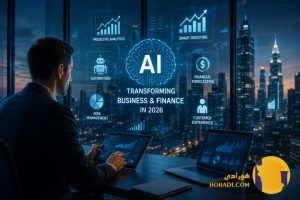
Financial institutions are early adopters of agentic systems. They use AI agents for fraud detection and transaction monitoring. This improves both speed and accuracy of financial controls.
Risk modeling is enhanced through continuous scenario simulation. Agents evaluate market conditions and adjust risk parameters dynamically. This reduces exposure to volatile financial environments.
Automated reporting systems generate compliance documentation. These systems reduce manual workload for regulatory teams. Accuracy improves due to standardized data pipelines.
Hedge funds and banks increasingly integrate AI-driven trading agents. These systems analyze market signals in real time. Execution decisions are optimized for latency and liquidity.
Challenges in Scaling Agentic AI Systems
Despite benefits, agentic AI introduces governance complexity. Autonomous decision-making requires strict oversight frameworks. Without control layers, systems can produce unpredictable outcomes.
Data security remains a primary concern for enterprises. Agents often access sensitive internal and external datasets. This increases the attack surface for potential breaches.
Model reliability is another critical challenge at scale. Hallucination risks can impact business-critical decisions. Validation pipelines are required to ensure output integrity.
Regulatory compliance is still evolving for autonomous systems. Governments are developing frameworks for AI accountability. Enterprises must align deployments with emerging standards.
Integration with Enterprise Software Ecosystems
Agentic AI thrives in interconnected software environments. Integration with CRM, ERP, and analytics platforms is essential. This enables seamless workflow automation across systems.
APIs act as the primary communication layer for agents. They allow execution of actions across multiple enterprise tools. This reduces friction between systems and data silos.
Low-code and no-code platforms are accelerating adoption. Business teams can configure agents without deep engineering expertise. This democratizes access to advanced automation.
Ecosystems from companies like Google and NVIDIA are driving infrastructure innovation. Their AI stacks support scalable agent deployment. This strengthens enterprise AI interoperability.
Ethical and Governance Considerations
Ethical deployment of agentic AI requires structured oversight. Bias mitigation is critical in autonomous decision systems. Uncontrolled outputs can lead to operational and reputational risks.
Transparency in agent decision-making is increasingly required. Explainability frameworks help trace AI reasoning paths. This builds trust in enterprise environments.
Governance models define boundaries for autonomous execution. These include permission layers and human-in-the-loop systems. They ensure accountability in critical workflows.
Industry frameworks from OpenAI and research bodies guide best practices. These standards evolve alongside technological advancement. Compliance is becoming a competitive advantage.
The Future Workforce Humans + AI Agents
The workforce of the future is fundamentally hybrid in nature. Humans focus on strategy, creativity, and oversight roles. AI agents handle execution-heavy and data-intensive tasks.
Job roles are evolving rather than disappearing entirely. New positions like AI workflow designers are emerging. These roles bridge human intent and machine execution.
Organizations are restructuring around capability-based teams. Agent clusters function as scalable digital departments. This reduces dependency on traditional hierarchical structures.
Long-term productivity gains depend on effective collaboration design. Human-AI coordination will define enterprise competitiveness. This marks a structural shift in organizational economics.
Final Verdict
Agentic AI represents a foundational shift in enterprise productivity. It moves automation from static scripts to autonomous decision systems. Businesses that adopt early gain structural operational advantages.
However, success depends on governance, integration, and oversight. Without these, scalability risks outweigh productivity gains. Balanced implementation is essential for sustainable impact.
The future belongs to organizations that master hybrid intelligence. Human expertise combined with digital co-workers defines the new norm. Agentic AI is not optional—it is becoming infrastructural.
FAQ Agentic AI and Digital Co-Workers
What is agentic AI and how is it different from traditional AI? Agentic AI can plan and execute multi-step tasks autonomously. Unlike traditional AI, it operates with goal-oriented reasoning systems. This enables full workflow automation instead of isolated tasks.
How do digital co-workers improve business productivity? They reduce manual workload by automating repetitive cognitive tasks. They also accelerate decision-making through real-time data analysis. This leads to faster and more efficient enterprise operations.
Are agentic AI systems safe for enterprise use? Yes, but only with proper governance and control frameworks. Human-in-the-loop systems are essential for critical decisions. Security and compliance layers must be implemented carefully.
Which industries benefit most from agentic AI? Finance, healthcare, logistics, and customer service lead adoption. These sectors rely heavily on data-driven decision processes. Agentic systems significantly improve speed and accuracy here.
What skills will be needed in an AI-driven workforce? Skills in AI orchestration, workflow design, and data literacy. Understanding system integration becomes increasingly important. Human-AI collaboration expertise will be highly valuable.