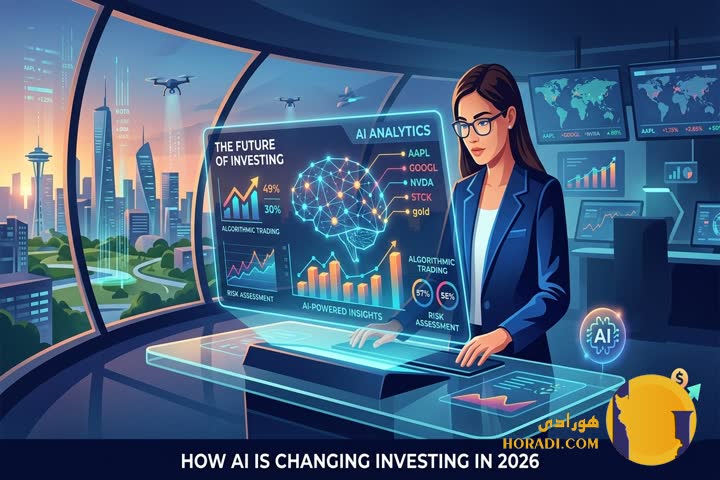
How AI Is Changing Investing in 2026

Artificial intelligence has become one of the most influential forces in modern finance. In 2026, AI-powered investing tools are helping individuals and institutions make faster, more informed decisions across global markets.
From algorithmic trading to personalized portfolio management, AI is reshaping how investors analyze opportunities. The technology now processes massive datasets in seconds, uncovering insights that traditional methods often miss.
Retail investors have gained unprecedented access to sophisticated tools once reserved for hedge funds. This democratization of financial intelligence is changing competitive dynamics throughout the investment industry.
As AI capabilities continue advancing, understanding their impact has become essential for anyone building wealth. Investors who adapt to these innovations may gain significant advantages in an increasingly data-driven market. Finance News
Key Takeaways
- AI investing is becoming mainstream across retail and institutional markets.
- Machine learning improves forecasting, portfolio construction, and risk assessment.
- Automated investing platforms offer greater personalization than traditional robo-advisors.
- Alternative data sources are creating new investment opportunities.
- AI helps investors react faster to market-moving events.
- Regulatory oversight remains critical as AI adoption expands.
- Human judgment still plays a vital role in investment decisions.
The Rise of AI-Powered Investing Platforms
AI investing platforms have evolved far beyond simple automation tools. Modern systems continuously learn from market behavior and adjust strategies based on changing conditions.
Retail investors can now access advanced analytics through user-friendly applications. These platforms simplify complex financial concepts while improving investment decision-making accuracy.
Leading financial firms are investing heavily in machine learning infrastructure. Their goal is to provide faster analysis, better forecasting, and improved customer experiences.
Competition among fintech companies has accelerated innovation across the sector. As a result, investors benefit from lower costs and increasingly sophisticated capabilities.
Popular AI Investing Features
| Feature | Primary Benefit |
|---|---|
| Portfolio Automation | Reduced manual management |
| Predictive Analytics | Enhanced forecasting |
| Risk Monitoring | Faster threat detection |
| Market Screening | Better opportunity discovery |
Machine Learning and Market Predictions
Machine learning models analyze enormous volumes of financial information daily. These systems identify patterns that would be nearly impossible for humans to detect manually.
Advanced algorithms evaluate historical price movements alongside current market conditions. This combination helps improve forecasting accuracy across various asset classes.
Investors increasingly use AI-generated signals to supplement traditional research methods. Rather than replacing analysts, these tools often enhance existing investment processes.
Although no prediction system is perfect, machine learning continues improving. Better data quality and computational power have significantly increased model effectiveness.
AI-Driven Portfolio Management
Portfolio management has become more dynamic through AI-powered optimization. Systems now adjust allocations based on market conditions, risk tolerance, and investor objectives.
Traditional portfolio reviews often occurred quarterly or annually. AI allows continuous monitoring and more frequent adjustments when necessary.
Personalized investing experiences have become a major competitive advantage. Platforms can create customized strategies tailored to individual financial goals.
These advancements help investors maintain diversification while pursuing stronger risk-adjusted returns. Efficient portfolio management remains one of AI’s most practical applications.
Alternative Data Is Reshaping Investment Research
Traditional financial statements remain important sources of information. However, investors increasingly supplement them with alternative datasets analyzed by AI.
Satellite imagery, supply chain data, consumer spending trends, and web activity provide valuable insights. AI systems process these complex inputs at remarkable speed.
Institutional investors have used alternative data for years. Today, technological advancements are making similar capabilities accessible to smaller investors.
This broader information landscape can reveal opportunities before they appear in conventional reports. Early identification often creates meaningful competitive advantages.
Common Alternative Data Sources
- Satellite imagery
- Social media sentiment
- Consumer transaction data
- Supply chain metrics
- Web traffic analytics
Automated Trading and Execution
Algorithmic trading continues expanding throughout global financial markets. AI-powered systems can execute trades based on predefined rules and real-time analysis.
Speed plays a critical role in modern investing environments. AI helps identify opportunities and execute transactions within milliseconds.
Institutional firms use sophisticated models to minimize transaction costs. Efficient execution can significantly improve long-term investment performance.
Retail investors increasingly benefit from similar technologies through brokerage platforms. Advanced automation is becoming a standard industry feature.
AI and Risk Management
Risk management has become more proactive thanks to artificial intelligence. Systems continuously monitor portfolios for signs of potential threats and vulnerabilities.
Machine learning models can identify unusual market conditions earlier than traditional approaches. Faster detection allows investors to respond more effectively.
Stress testing has also improved significantly through advanced simulations. AI evaluates thousands of scenarios to assess potential portfolio outcomes.
These capabilities help investors better understand uncertainty in complex markets. Effective risk management remains essential regardless of investment strategy.
Personalized Investing Reaches New Levels
Personalization has become a defining trend within financial technology. AI platforms tailor recommendations based on individual preferences and behavioral patterns.
Investors receive customized insights aligned with their unique goals. This approach creates more relevant and actionable financial guidance.
Traditional one-size-fits-all strategies are becoming less common. Advanced algorithms enable highly individualized portfolio construction and management.
Improved personalization may enhance investor engagement and long-term discipline. Better alignment between strategy and objectives often produces stronger outcomes.
The Role of Generative AI in Finance
Generative AI is expanding beyond content creation into financial analysis. These systems can summarize reports, explain market events, and assist research workflows.
Financial professionals use generative tools to improve productivity. Automation reduces time spent on repetitive tasks and information gathering.
Investors benefit from faster access to understandable market insights. Complex financial information becomes easier to interpret and evaluate.
While generative AI offers substantial advantages, verification remains important. Human oversight helps ensure accuracy and responsible decision-making.
Institutional Adoption Continues Accelerating
Large financial institutions are among the biggest investors in AI technologies. Banks, asset managers, and hedge funds continue expanding their capabilities.
The pursuit of operational efficiency remains a major driver. AI can reduce costs while improving analysis and client service quality.
Competitive pressures also encourage widespread adoption. Firms that fail to innovate may struggle against more technologically advanced competitors.
Industry leaders increasingly view AI as a strategic necessity rather than an optional enhancement. This shift is reshaping financial markets globally.
Regulatory and Ethical Challenges
As AI adoption grows, regulators are increasing oversight of automated systems. Transparency and accountability remain critical priorities throughout the financial sector.
Investment firms must ensure models operate fairly and consistently. Bias, explainability, and data governance continue attracting significant attention.
Regulatory frameworks are evolving alongside technological innovation. Policymakers aim to balance investor protection with continued industry growth.
Organizations that prioritize responsible AI practices may gain stronger trust. Ethical implementation is becoming an important competitive differentiator.
Human Investors Still Matter
Despite rapid technological advancement, human expertise remains valuable. Successful investing often requires judgment, experience, and contextual understanding.
AI excels at processing data and identifying patterns efficiently. However, broader strategic thinking still benefits from human involvement.
Many professionals now use AI as a decision-support tool rather than a replacement. Combining human insight with machine intelligence often delivers the best results.
The future of investing is likely to be collaborative. Investors who effectively integrate both strengths may achieve superior outcomes.
High-Authority Sources on AI Investing
The following organizations provide authoritative research and analysis regarding AI and financial markets
- International Monetary Fund (IMF)
- World Economic Forum (WEF)
- CFA Institute
These institutions regularly publish research on artificial intelligence, financial markets, risk management, and investment innovation.
Final Verdict
Artificial intelligence is fundamentally changing investing in 2026. From predictive analytics and portfolio optimization to automated trading and personalized recommendations, AI is becoming an essential component of modern wealth management.
The technology offers significant advantages in efficiency, scalability, and data analysis. However, successful investing still requires sound judgment, proper risk management, and a clear understanding of market fundamentals.
Investors who embrace AI responsibly while maintaining disciplined investment principles are likely to be best positioned for the future. The combination of human expertise and machine intelligence is shaping the next generation of financial decision-making.
FAQ
1. How is AI used in investing in 2026?
AI is used for market analysis, portfolio management, risk assessment, automated trading, predictive modeling, and personalized investment recommendations. Modern platforms leverage machine learning to process large datasets and identify investment opportunities.
2. Can AI outperform human investors?
AI can outperform humans in data processing, pattern recognition, and execution speed. However, human judgment remains important for strategic decisions, macroeconomic interpretation, and managing unexpected market events.
3. What are the best AI investing tools available today?
Leading AI investing tools typically include portfolio optimization platforms, robo-advisors, algorithmic trading systems, and AI-powered research assistants. Features vary based on investor goals and experience levels.
4. Is AI investing safe for beginners?
AI investing can be useful for beginners because many platforms automate complex tasks. However, investors should still understand risk, diversification, and long-term financial planning before committing capital.
5. What risks come with AI-powered investing?
Potential risks include model errors, data quality issues, overreliance on automation, market volatility, and regulatory changes. Investors should combine AI insights with independent analysis and sound risk management practices.