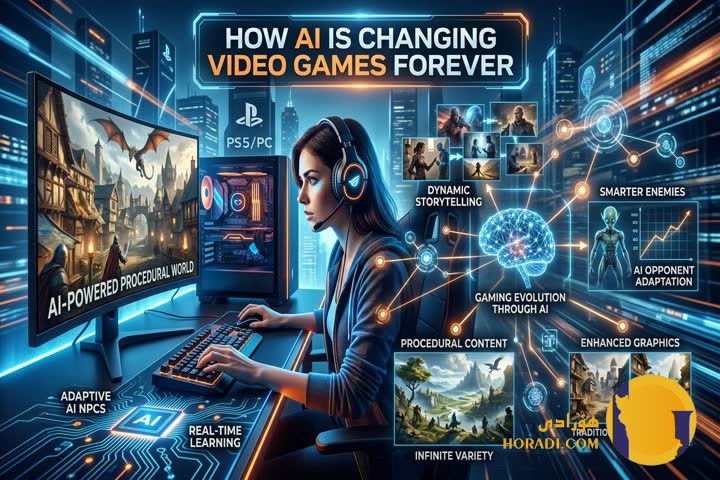
How AI Is Changing Video Games Forever

Artificial intelligence has become one of the most disruptive technologies in gaming. What began as simple scripted behaviors has evolved into sophisticated systems capable of creating dynamic worlds, adaptive characters, and personalized player experiences.
Game developers are increasingly integrating AI-powered tools into production pipelines. These technologies help studios create larger games, reduce development costs, and deliver richer content than ever before.
At the same time, players are experiencing more immersive gameplay. Modern AI systems can respond intelligently to decisions, making virtual worlds feel more realistic and unpredictable.
As of June 2026, AI is influencing nearly every aspect of game development and gameplay. From character behavior to content generation, the impact is permanent and continues to accelerate. Game News
Key Takeaways
- AI-driven NPCs are becoming more realistic and responsive.
- Procedural generation is creating larger and more diverse worlds.
- Developers use AI to speed up production and reduce costs.
- Personalized gameplay is improving player engagement.
- AI-generated dialogue is transforming storytelling.
- Game testing and quality assurance are becoming more efficient.
- Future games will likely feature fully adaptive experiences.
The Evolution of AI in Video Games
Early video game AI relied on simple scripts and predefined rules. Characters followed predictable paths and reacted the same way during every playthrough.
Developers used finite state machines and behavior trees to simulate intelligence. While effective, these systems often produced repetitive and unrealistic gameplay experiences.
Modern machine learning technologies have expanded what is possible. AI can now analyze player behavior and adjust game mechanics dynamically in real time.
This evolution marks a fundamental shift in gaming design. Instead of static experiences, developers can create worlds that continuously adapt and evolve.
Smarter NPCs Are Transforming Gameplay
Non-player characters have traditionally followed scripted behaviors. Players could often predict enemy movements and exploit repeating patterns.
Today’s AI-powered NPCs can react intelligently to changing situations. They evaluate environments, learn from encounters, and make more realistic decisions.
This improvement creates greater immersion for players. Interactions feel less mechanical and more like engaging with intelligent virtual beings.
Many modern titles use advanced AI systems to simulate teamwork. Enemies coordinate attacks, communicate threats, and adapt strategies during combat.
AI-Powered Storytelling Creates Dynamic Narratives
Storytelling is one of the most exciting areas of AI innovation. Developers can now generate dialogue and narrative variations at unprecedented scales.
Traditional branching narratives require extensive writing resources. AI systems help expand possibilities while maintaining narrative consistency across different choices.
Players increasingly expect stories that respond to their decisions. AI enables personalized character interactions and more meaningful consequences.
These technologies are making games feel unique to every player. Two people may experience significantly different storylines within the same game.
Procedural World Generation Is Expanding Possibilities
Procedural generation has existed for years in gaming. However, AI significantly enhances the quality and complexity of generated environments.
Modern systems can create realistic landscapes, cities, and ecosystems. These worlds feel handcrafted despite being generated algorithmically.
Developers benefit from reduced content creation workloads. AI can produce large amounts of environmental content while maintaining visual coherence.
Players gain access to nearly limitless exploration opportunities. Dynamic worlds increase replayability and keep experiences fresh over time.
Benefits of AI-Powered World Generation
| Advantage | Impact |
|---|---|
| Faster Development | Reduces manual asset creation |
| Larger Maps | Enables massive game worlds |
| Increased Variety | Generates unique environments |
| Better Replayability | Creates new experiences each session |
Personalized Gaming Experiences Are Becoming Standard
AI systems analyze player preferences and behavior patterns. This information helps games tailor experiences to individual users.
Difficulty adjustments are becoming increasingly sophisticated. Games can balance challenge levels without disrupting player enjoyment.
Personalized recommendations also improve content discovery. Players receive missions, rewards, and experiences aligned with their interests.
These adaptive systems increase engagement and retention. Developers benefit from higher player satisfaction and longer play sessions.
AI Is Revolutionizing Game Development
Game development is a resource-intensive process requiring significant investment. AI tools help automate repetitive tasks and improve efficiency.
Developers use AI for animation, asset generation, coding assistance, and content creation. These capabilities accelerate production timelines.
Smaller studios particularly benefit from these innovations. Teams can achieve results previously requiring much larger budgets and workforces.
As AI tools continue improving, development workflows are becoming more streamlined. This allows creators to focus on innovation and design.
Advanced Enemy Behavior Creates Better Challenges
Enemy AI has progressed far beyond scripted attack patterns. Modern opponents can evaluate situations and adapt tactics dynamically.
Players now face challenges that feel more authentic. Opponents respond intelligently rather than following predetermined routines.
Adaptive enemy behavior improves long-term engagement. Players cannot rely solely on memorized strategies to achieve success.
This shift encourages creativity and experimentation. Every encounter has the potential to unfold differently based on player actions.
AI Improves Game Testing and Quality Assurance
Quality assurance remains one of the most demanding aspects of development. Large games contain countless systems requiring extensive testing.
AI-powered testing tools can simulate thousands of gameplay scenarios. This helps identify bugs and balancing issues more efficiently.
Automated testing reduces development bottlenecks significantly. Teams can focus resources on solving problems rather than locating them.
The result is higher-quality releases with improved stability. Players benefit from fewer technical issues and smoother experiences.
Generative AI Is Reshaping Content Creation
Generative AI tools are transforming how game content is produced. Developers can create assets, dialogue, and concepts more rapidly.
These technologies assist artists and writers rather than replacing them. Human creativity remains essential for maintaining quality and vision.
Studios use AI to accelerate brainstorming and prototyping processes. Early development stages become faster and more flexible.
The combination of human expertise and AI assistance creates powerful workflows. This partnership is becoming increasingly common throughout the industry.
Common Generative AI Applications
- Character concepts
- Environmental design
- Dialogue generation
- Quest creation
- Voice synthesis
- Animation assistance
The Challenges and Ethical Questions of AI Gaming
Despite its benefits, AI introduces important challenges. Concerns regarding intellectual property, transparency, and content ownership remain significant.
Developers must carefully balance automation with human creativity. Excessive reliance on AI may impact artistic uniqueness and originality.
Privacy considerations also require attention. Personalized experiences depend on data collection and responsible usage practices.
Industry leaders continue developing standards and guidelines. Responsible implementation will play a major role in AI’s future success.
What the Future of AI Gaming Looks Like
The next generation of games will likely become even more adaptive. AI systems may generate content continuously based on player behavior.
Virtual characters could engage in natural conversations. Advances in language models are making this possibility increasingly realistic.
Persistent worlds may evolve independently of player actions. Entire ecosystems could react dynamically to changing conditions over time.
As technology advances, the line between scripted entertainment and living virtual worlds will continue to blur. AI is positioned at the center of this transformation.
High-Authority Sources on AI and Gaming
Researchers and industry professionals frequently reference the following organizations for developments in AI and gaming
- NVIDIA Research
- Microsoft Research
- International Game Developers Association (IGDA)
These organizations publish research, technical papers, and industry insights that help shape the future direction of AI-driven game development.
Final Verdict
Artificial intelligence is fundamentally reshaping the video game industry. From smarter NPCs and dynamic storytelling to procedural world generation and automated development workflows, AI is influencing every stage of the gaming ecosystem.
The technology enables more immersive experiences, greater personalization, and faster production cycles. While ethical and creative challenges remain, the long-term trajectory is clear AI is not simply enhancing video games—it is redefining how they are created and experienced.
As the industry moves deeper into 2026 and beyond, developers that successfully combine human creativity with intelligent systems will likely lead the next era of interactive entertainment. How AI Is Changing Video Games Forever
FAQ
1. How is AI used in video games in 2026?
AI is used for NPC behavior, procedural world generation, personalized gameplay, content creation, game testing, animation, and dynamic storytelling systems.
2. Can AI create entire video games by itself?
AI can assist with many development tasks, but human designers, artists, writers, and engineers remain essential for creative direction and quality control.
3. What are AI-powered NPCs?
AI-powered NPCs are characters that use advanced algorithms to react dynamically, learn from situations, and provide more realistic interactions.
4. Is generative AI replacing game developers?
No. Generative AI primarily serves as a productivity tool that helps developers work faster and explore more creative possibilities.
5. What is the biggest benefit of AI in gaming?
The biggest benefit is the ability to create more immersive, adaptive, and personalized experiences while improving development efficiency and scalability.