
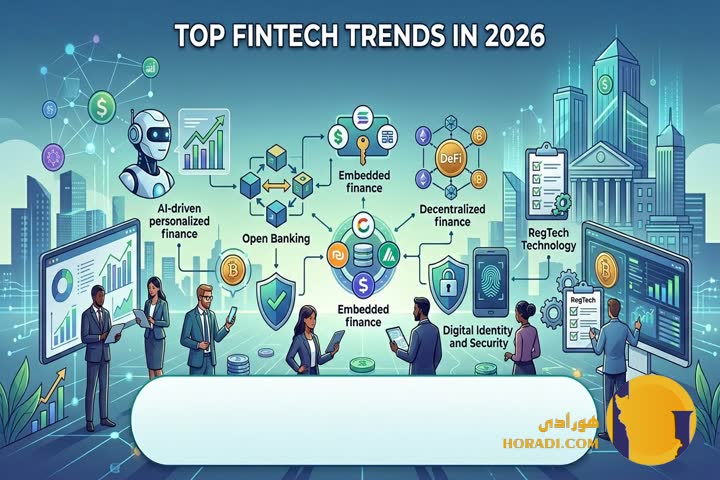
Top Fintech Trends in 2026

Fintech in 2026 is no longer just about digital banking apps or mobile wallets. It has evolved into a deeply integrated financial ecosystem powered by AI, data, and automation. Institutions, startups, and regulators are now converging on a new financial architecture.
The global fintech landscape is being reshaped by real-time infrastructure, intelligent automation, and regulatory modernization. According to the Bank for International Settlements (BIS), digital financial systems are entering a “programmable money era.” At the same time, firms like McKinsey & Company highlight rapid acceleration in AI-led financial services transformation.
The key drivers include customer demand for frictionless experiences, cost optimization pressure, and regulatory digitization. Fintech innovation in 2026 is not optional—it is structural and systemic. Below are the most important trends defining this transformation. Finance News
Key Takeaways
- AI is becoming the core operating system of modern banking
- Embedded finance is dissolving traditional financial boundaries
- CBDCs and real-time payments are reshaping global liquidity systems
- Regulatory technology is fully automating compliance workflows
- Tokenization is unlocking new asset liquidity models
1. AI-Driven Banking Automation
Banks in 2026 are increasingly operating as AI-first institutions rather than human-first organizations. Core banking systems now rely on machine learning models for decision-making workflows. This shift reduces operational friction while improving real-time responsiveness.
AI is handling underwriting, credit scoring, and personalized financial recommendations at scale. Natural language interfaces are replacing legacy dashboards in many financial platforms. Customer interactions are increasingly autonomous and context-aware.
Operational efficiency gains are significant across mid-tier and large financial institutions. AI orchestration layers are now embedded into core fintech infrastructure stacks. This is redefining what “banking operations” actually mean.
Risk modeling has also improved with adaptive AI systems analyzing live financial data. Traditional rule-based systems are being phased out in favor of predictive intelligence. This transition is improving fraud detection and portfolio management simultaneously.
2. Embedded Finance Expansion
Embedded finance is becoming the default financial distribution model in 2026. Non-financial platforms now integrate payments, lending, and insurance natively. This eliminates the need for users to interact with traditional banking interfaces.
E-commerce, SaaS, and mobility platforms are leading embedded financial adoption. Financial services are now API-driven and seamlessly integrated into user journeys. This creates frictionless transactional ecosystems across industries.
Revenue models are shifting from subscriptions to transaction-based financial services. Companies are monetizing financial layers inside their existing platforms. This significantly expands total addressable market opportunities.
Consumer expectations are also evolving toward invisible finance experiences. Users increasingly expect instant credit, payments, and protection without apps. Embedded finance is effectively dissolving banking visibility.
3. Real-Time Payments and CBDCs
Real-time payment infrastructure has become standard across major economies in 2026. Settlement delays are increasingly obsolete due to instant clearing systems. Central banks are actively supporting this shift through digital currency pilots.
Central Bank Digital Currencies (CBDCs) are moving from pilots to limited production use. Governments are testing programmable money frameworks for fiscal policy execution. This introduces new levels of monetary precision and control.
Cross-border payments are becoming faster and significantly cheaper. Legacy correspondent banking systems are being replaced by blockchain rails. This improves global trade efficiency and financial inclusion.
Liquidity management is also evolving due to continuous settlement systems. Financial institutions must now operate under 24/7 liquidity constraints. This is reshaping treasury operations worldwide.
4. DeFi and Regulatory Convergence
Decentralized finance is no longer operating in a fully unregulated environment. Regulators are introducing structured frameworks for DeFi protocols. This is reducing systemic risk while enabling institutional participation.
Hybrid financial systems are emerging that combine DeFi and traditional finance. Smart contracts are being audited and standardized for compliance integration. This improves trust and scalability across decentralized platforms.
Institutional capital is cautiously entering regulated DeFi ecosystems. Risk management frameworks are being embedded directly into protocols. This is improving stability in previously volatile markets.
The convergence is also driving innovation in on-chain identity and governance. Protocols are increasingly aligned with financial regulatory expectations. This marks a shift from experimental to institutional-grade DeFi.
5. Open Banking 2.0 APIs
Open banking has evolved into a more advanced “Open Banking 2.0” framework. APIs now support real-time financial data sharing across ecosystems. This enables deeper integration between banks and fintech platforms.
Data portability has become a core consumer financial right in many regions. Users can move financial data seamlessly across providers. This increases competition and improves service quality.
Financial institutions are monetizing API ecosystems at scale. B2B financial infrastructure is becoming a major revenue stream. This transforms banks into platform-based service providers.
Security standards have also matured significantly in API ecosystems. Advanced authentication and encryption protocols reduce data exposure risk. This ensures compliance with evolving global regulations.
6. AI-Powered Fraud Detection Systems
Fraud detection systems in 2026 are primarily AI-driven and adaptive. Static rule-based detection systems are no longer sufficient. Machine learning models continuously evolve based on transaction patterns.
Financial institutions now detect anomalies in milliseconds. Behavioral biometrics are used to validate user identity in real time. This significantly reduces account takeover incidents.
Cross-network fraud intelligence sharing is becoming more common. Banks collaborate through shared AI risk detection frameworks. This strengthens systemic financial security.
Synthetic identity fraud is being addressed using advanced graph analytics. AI models map complex identity relationships across datasets. This improves detection accuracy and reduces false positives.
7. RegTech and Automated Compliance
Regulatory technology (RegTech) is fully embedded in financial operations in 2026. Compliance is increasingly automated through AI-driven monitoring systems. Manual reporting processes are being phased out globally.
Real-time compliance tracking ensures continuous regulatory alignment. Financial institutions no longer rely on periodic audits alone. This improves transparency and reduces operational risk.
Regulators themselves are adopting AI tools for supervision. This creates a two-way digital compliance ecosystem. Oversight becomes more predictive than reactive.
Cost of compliance has significantly decreased due to automation. Smaller fintech firms can now scale without heavy regulatory overhead. This encourages innovation while maintaining system stability.
8. Digital Identity and Biometric Authentication
Digital identity systems have become foundational in fintech ecosystems. Biometric authentication is replacing passwords across financial platforms. This improves both security and user experience.
Governments are increasingly issuing digital identity frameworks. These systems integrate financial, medical, and civic data securely. This creates unified identity verification ecosystems.
Fintech platforms rely on real-time identity verification APIs. KYC processes are now near-instant and fully automated. This reduces onboarding friction significantly.
Privacy-preserving technologies like zero-knowledge proofs are expanding. Users can verify identity without exposing sensitive data. This balances compliance with data protection requirements.
9. WealthTech and Robo-Advisors 2.0
Wealth management platforms have evolved into AI-driven advisory systems. Robo-advisors now use macroeconomic and behavioral datasets simultaneously. This improves portfolio personalization at scale.
Investment strategies are dynamically adjusted based on real-time signals. Market sentiment analysis is integrated into asset allocation models. This increases responsiveness to volatility.
Retail investors now access institutional-grade investment tools. Barriers between retail and professional finance are shrinking rapidly. This democratizes wealth management globally.
Hybrid advisory models combine AI with human financial advisors. This ensures emotional intelligence in complex financial planning. The model improves trust and decision accuracy.
10. Tokenization of Real-World Assets
Tokenization is transforming traditional asset classes into digital instruments. Real estate, commodities, and bonds are increasingly represented on-chain. This improves liquidity and fractional ownership opportunities.
Financial markets are becoming more accessible through tokenized platforms. Investors can now access previously illiquid asset classes easily. This expands global investment participation.
Institutional adoption is accelerating due to improved regulatory clarity. Tokenized securities are being integrated into traditional exchanges. This bridges traditional finance and blockchain ecosystems.
Settlement efficiency has improved significantly through token infrastructure. Ownership transfers are now near-instant and transparent. This reduces friction in global capital markets.
Final Verdict
Fintech in 2026 is defined by convergence rather than fragmentation. AI, blockchain, and regulatory automation are merging into unified systems. The result is a faster, more intelligent, and more embedded financial ecosystem.
According to McKinsey & Company, AI-led financial transformation is now a top strategic priority for global banks. The Bank for International Settlements (BIS) emphasizes programmable money as a structural shift in monetary systems. The International Monetary Fund (IMF) continues to highlight digital finance as a core driver of global economic resilience.
The industry is moving toward invisible, automated, and always-on financial systems. Institutions that fail to adapt risk structural obsolescence. Fintech is no longer a sector—it is the infrastructure of modern finance.
FAQ
1. What is the biggest fintech trend in 2026? AI-driven automation in banking is the most dominant trend reshaping financial services globally.
2. How is embedded finance changing traditional banking? It removes the need for standalone banking apps by integrating financial services into non-financial platforms.
3. Are CBDCs widely used in 2026? They are in pilot and early deployment stages across several major economies, not yet fully global.
4. What role does AI play in fintech security? AI is central to fraud detection, identity verification, and real-time risk monitoring systems.
5. Is tokenization replacing traditional assets? Not replacing, but augmenting them by improving liquidity, accessibility, and settlement efficiency.