
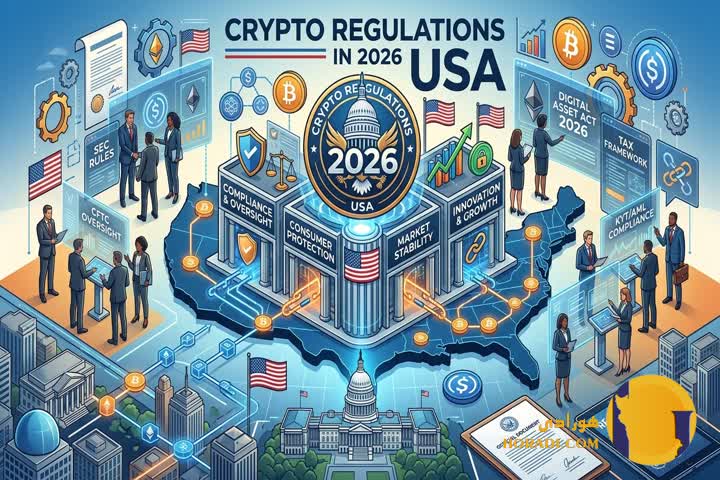
Crypto Regulations in 2026 USA

The U.S. crypto regulatory environment in 2026 is defined by convergence. Multiple federal agencies now coordinate enforcement more tightly than ever. This shift has reduced ambiguity but increased compliance pressure significantly.
Institutional adoption has forced regulators to mature rapidly. Bitcoin ETFs, tokenized securities, and stablecoins are now mainstream instruments. As a result, regulation is no longer reactive—it is structural and ongoing.
Key regulatory authorities include the SEC, CFTC, IRS, and FinCEN. Major frameworks such as digital asset reporting rules and stablecoin guidance shape compliance. High-authority sources include SEC releases, CFTC enforcement reports, and IRS crypto tax guidance. Finance Crypto News
Key Takeaways
- U.S. crypto regulation in 2026 is stricter and more coordinated
- SEC and CFTC share overlapping jurisdiction over digital assets
- Stablecoin and DeFi rules are now central to compliance strategy
- IRS enforcement on crypto taxation has significantly expanded
- Institutional adoption is driving clearer but heavier regulation
1. U.S. Crypto Regulatory Landscape in 2026
The regulatory landscape is now multi-agency and highly structured. SEC and CFTC jointly oversee classification of digital assets. This dual-framework reduces loopholes but increases compliance complexity.
Legislative momentum from earlier acts continues shaping policy. Congressional efforts around digital asset market structure remain influential. Regulators now rely heavily on enforcement precedents to define rules.
Market participants must navigate overlapping federal requirements. State-level regulations still apply in parallel with federal oversight. This creates a layered compliance environment for all crypto firms.
The result is a more predictable but stricter market framework. Companies must invest heavily in legal and compliance infrastructure. Regulatory clarity now comes at the cost of operational flexibility.
2. SEC Oversight and Securities Classification
The SEC remains the dominant authority for token classification. Most tokens are evaluated under the Howey Test framework. This determines whether a crypto asset qualifies as a security.
In 2026, enforcement has expanded significantly across DeFi platforms. Unregistered securities offerings remain a top enforcement priority. Exchanges are required to maintain strict listing compliance reviews.
SEC reporting standards now mirror traditional capital markets rules. Public disclosures are required for tokenized securities issuers. This has increased transparency but reduced anonymity in markets.
Coordination with courts has strengthened regulatory interpretation. Several landmark cases now guide token classification precedent. This has reduced ambiguity but increased litigation risk.
3. CFTC Regulation of Digital Commodities
The CFTC regulates cryptocurrencies classified as commodities. Bitcoin and Ethereum remain primary examples under this category. This distinction is critical for derivatives and futures markets.
In 2026, derivatives trading oversight has expanded significantly. Crypto futures and options markets are now deeply institutionalized. Regulated exchanges must meet strict reporting and margin rules.
The CFTC focuses heavily on market manipulation prevention. Surveillance systems track large-scale trading anomalies in real time. This ensures integrity in high-volume digital commodity markets.
Coordination with the SEC remains essential for jurisdiction clarity. Dual oversight reduces regulatory arbitrage opportunities significantly. This has created a more unified enforcement environment overall.
4. IRS Crypto Taxation and Reporting Rules
The IRS has significantly expanded crypto tax enforcement in 2026. Digital asset transactions are treated as taxable events by default. Capital gains reporting is now highly automated through brokers.
Mandatory reporting from exchanges has increased transparency levels. Form 1099-DA and similar reporting tools are widely used. This reduces underreporting but increases taxpayer compliance burden.
Tax treatment varies depending on asset classification and usage. Staking rewards, DeFi yields, and NFTs all have distinct rules. This creates complexity for retail and institutional investors alike.
IRS enforcement relies heavily on blockchain analytics tools. Cross-platform transaction tracking is now highly sophisticated. This limits anonymity in most mainstream crypto ecosystems.
5. Stablecoin Regulation and Reserve Requirements
Stablecoins are now one of the most regulated crypto segments. Federal frameworks require full reserve backing and audit transparency. Issuers must maintain strict liquidity and redemption standards.
In 2026, systemic risk concerns dominate regulatory discussions. Large stablecoin issuers are treated similarly to financial institutions. This includes stress testing and capital adequacy requirements.
Payment-focused stablecoins are integrated into banking infrastructure. Regulators emphasize interoperability with traditional finance systems. This has increased mainstream adoption while tightening oversight.
Reserve reporting is audited by approved financial institutions. Monthly disclosures are required for all major issuers. This ensures stability but reduces operational flexibility.
6. DeFi Regulation and Smart Contract Compliance
Decentralized finance is no longer outside regulatory scope. In 2026, DeFi protocols face indirect but strong regulatory pressure. Front-end operators are often treated as financial intermediaries.
Smart contract governance is increasingly scrutinized by regulators. Protocols must implement compliance-friendly access controls. This includes geo-restrictions and identity verification layers.
Regulators focus on AML and fraud prevention in DeFi systems. Liquidity pools and lending protocols face heightened oversight. This reduces anonymity but improves investor protection.
Legal responsibility often falls on developers and DAO operators. This has created uncertainty around decentralized governance models. Compliance expectations continue to evolve rapidly.
7. AML and KYC Enforcement (FinCEN Framework)
FinCEN plays a central role in anti-money laundering enforcement. Crypto exchanges must implement strict KYC verification systems. This includes identity checks for nearly all transaction tiers.
Transaction monitoring systems are now mandatory for compliance. Suspicious activity reporting is required in near real time. This aligns crypto markets with traditional banking standards.
Travel Rule compliance has become industry standard practice. User identity data must accompany cross-platform transfers. This reduces illicit flow but increases data management complexity.
FinCEN collaborates closely with international regulators. Global AML alignment is now a key regulatory objective. This strengthens cross-border enforcement consistency.
8. State-Level Crypto Regulation in the U.S.
State regulators continue to play a significant role in 2026. New York’s BitLicense remains one of the strictest frameworks. Other states have adopted more flexible licensing systems.
States now compete to attract blockchain companies and startups. Regulatory sandboxes are increasingly common in innovation hubs. This encourages experimentation under controlled conditions.
Compliance requirements vary significantly across jurisdictions. Firms must maintain multi-state licensing strategies. This increases operational cost and legal complexity.
State regulators coordinate with federal agencies more closely. This reduces conflicting enforcement actions over time. However, full harmonization has not yet been achieved.
9. Exchange Compliance and Institutional Infrastructure
Crypto exchanges operate under strict compliance frameworks in 2026. Licensing, auditing, and reporting standards mirror traditional finance. This ensures institutional-grade market infrastructure.
Custody solutions are heavily regulated and insured. Cold storage and asset segregation are mandatory requirements. This improves security but increases operational overhead.
Market surveillance tools are integrated into trading systems. Real-time monitoring detects manipulation and insider activity. This enhances market integrity significantly.
Institutional onboarding requires extensive compliance checks. KYC, AML, and tax verification are standard procedures. This limits frictionless trading but increases trust.
10. Institutional Adoption and Regulatory Impact
Institutional participation has reshaped crypto regulation entirely. Banks, hedge funds, and asset managers dominate trading volumes. This has accelerated regulatory convergence with TradFi systems.
ETF structures and tokenized securities are now mainstream. Regulators treat these products under established securities law. This reduces ambiguity for large-scale investors.
Risk management standards are significantly more advanced. Institutions must comply with capital and exposure limits. This stabilizes markets but reduces speculative volatility.
Regulation now prioritizes systemic financial stability. Crypto is increasingly integrated into global financial infrastructure. This marks a shift from disruption to regulated adoption.
Final Verdict
U.S. crypto regulation in 2026 is defined by maturity and enforcement depth. The era of regulatory uncertainty has largely transitioned into structured oversight. However, this clarity comes with significantly higher compliance costs.
SEC, CFTC, IRS, and FinCEN now operate in near-aligned coordination. Stablecoins and institutional products drive the strongest regulatory focus. DeFi remains the most uncertain but rapidly evolving frontier.
The overall direction is clear integration, not isolation. Crypto is becoming a regulated extension of traditional finance systems. Businesses that adapt early will dominate the next regulatory cycle.
FAQ Crypto Regulations in the USA (2026)
Q1 Are cryptocurrencies legal in the United States in 2026? Yes, crypto is fully legal but heavily regulated across federal and state levels. Compliance requirements depend on asset classification and usage type. Regulators focus on investor protection and financial stability.
Q2 Which agency regulates crypto the most in 2026? The SEC leads securities-related oversight of tokens and offerings. The CFTC regulates commodity-based crypto assets like Bitcoin. FinCEN and IRS handle AML and taxation respectively.
Q3 How are crypto taxes enforced in 2026? The IRS uses automated exchange reporting and blockchain analytics. Most transactions are classified as taxable capital gains events. Non-compliance risks include penalties and audits.
Q4 Are DeFi platforms regulated now? Yes, DeFi is indirectly regulated through intermediaries and interfaces. Developers and operators may face compliance obligations. AML and fraud prevention rules apply broadly.
Q5 What is the biggest regulatory trend in 2026 crypto markets? The biggest trend is convergence with traditional financial regulation. Stablecoins and institutional adoption are driving stricter oversight. Regulation is now focused on integration, not restriction.