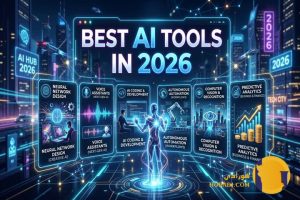
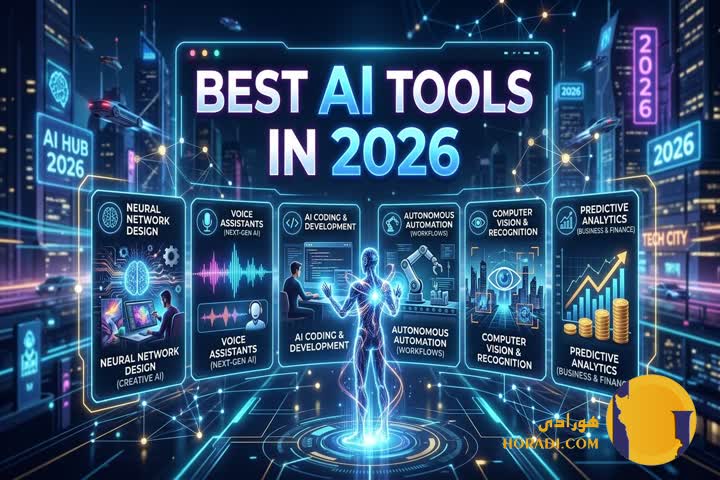
Best AI Tools in 2026

Artificial intelligence in 2026 is no longer experimental or niche. It has become the core infrastructure behind modern digital workflows. From finance to software engineering, AI now drives decision-making at scale.
The shift is no longer about whether to use AI tools. It is about choosing the right ecosystem for speed, accuracy, and governance. Organizations now compete based on AI adoption maturity, not just capital.
Leading ecosystems from OpenAI, Google DeepMind, and Microsoft are setting benchmarks. Their models are now deeply embedded into enterprise and consumer platforms. This guide breaks down the most impactful AI tools shaping 2026 workflows. Technology Ai
Key Takeaways
- AI tools in 2026 are fully integrated into enterprise infrastructure
- OpenAI, Google DeepMind, and Microsoft dominate foundational ecosystems
- Vertical AI tools outperform general-purpose solutions in specialized workflows
- Finance, coding, and marketing remain the highest ROI AI adoption areas
- Governance and AI compliance tools are now mandatory in enterprise stacks
1. The 2026 AI Ecosystem Landscape
The AI ecosystem in 2026 is structured around multi-model orchestration. Instead of single tools, companies rely on interconnected AI stacks. These stacks combine reasoning models, agents, and domain-specific engines.
OpenAI’s GPT-5-class systems remain central in productivity workflows. Google DeepMind’s Gemini ecosystem leads in multimodal reasoning systems. Microsoft integrates AI deeply into enterprise software through Copilot layers.
A major shift is the rise of agent-based architectures. These systems autonomously execute workflows across tools and APIs. They reduce manual intervention in complex digital operations significantly.
Competition is now defined by latency, context length, and integration depth. The fastest ecosystems dominate enterprise adoption cycles. This has created a fragmented but highly competitive AI market.
2. Best General-Purpose AI Assistants in 2026
General-purpose AI assistants remain the most widely adopted category. They handle writing, analysis, coding, summarization, and planning tasks. Most organizations deploy at least one as a default productivity layer.
The most advanced systems now include persistent memory features. They adapt to user behavior across sessions and enterprise environments. This significantly improves workflow continuity and personalization.
A typical stack includes OpenAI-based assistants and Google Gemini tools. Microsoft Copilot remains dominant in enterprise Office ecosystems. These systems are often used together rather than in isolation.
Performance benchmarks in 2026 prioritize reasoning accuracy and speed. Context windows exceeding one million tokens are now becoming standard. This enables full project-level understanding in a single session.
3. AI Coding Tools and Developer Platforms
AI coding tools have fundamentally reshaped software engineering workflows. Developers now rely heavily on AI pair-programming assistants daily. These tools reduce debugging time and accelerate feature delivery cycles.
GitHub Copilot remains a dominant force in enterprise development pipelines. It is tightly integrated into CI/CD workflows and code review systems. OpenAI-based coding agents enhance multi-language development efficiency.
New tools now generate entire microservices from natural language prompts. They also perform automated refactoring and dependency optimization. This reduces manual engineering overhead significantly in large codebases.
Developer productivity gains range from 30% to 70% depending on use case. However, governance and code validation remain critical checkpoints. Human oversight is still required for production-grade deployments.
4. AI Marketing and Content Generation Tools
AI marketing tools now dominate digital content production pipelines. They generate SEO articles, ad copy, and full campaign strategies. Marketers increasingly act as editors rather than primary creators.
Platforms like Jasper AI and enterprise GPT systems lead this category. They integrate with analytics tools to optimize conversion performance. This enables real-time content adaptation based on user behavior.
AI-driven SEO systems now analyze SERP trends in real time. They automatically adjust keyword strategies based on ranking shifts. This has significantly reduced manual SEO research workloads.
Content personalization at scale is now the industry standard. Brands deploy thousands of AI-generated variations per campaign. Performance optimization is fully automated in advanced marketing stacks.
5. AI Tools for Finance and Investment Analysis
Finance is one of the most AI-transformed industries in 2026. AI systems now assist in trading, risk analysis, and portfolio management. They process massive datasets faster than traditional quantitative models.
Bloomberg-integrated AI systems remain highly influential in institutions. They combine real-time market data with predictive analytics engines. Hedge funds increasingly rely on AI-driven alpha generation models.
Retail investors also benefit from AI-powered advisory platforms. These tools simulate portfolio outcomes based on macroeconomic conditions. They reduce information asymmetry between retail and institutional players.
Risk modeling is now largely automated using probabilistic AI systems. However, regulatory oversight from bodies like the SEC remains strict. Explainability is a mandatory feature in financial AI deployments.
6. AI Design and Creative Generation Tools
Creative industries have been transformed by generative AI platforms. Designers now use AI for rapid prototyping and visual ideation. This reduces production timelines across digital media pipelines.
Tools like Adobe Firefly and Midjourney-class systems dominate workflows. They generate high-resolution assets from simple text descriptions. These systems are widely used in advertising and entertainment sectors.
AI now supports dynamic branding systems that evolve automatically. Visual identity systems adapt based on audience engagement metrics. This creates highly responsive brand ecosystems in real time.
Despite automation, human creativity remains essential for direction. AI acts as an accelerator rather than a replacement for designers. The best results come from hybrid human-AI creative workflows.
7. Productivity and Workflow Automation AI Tools
AI-driven productivity tools are central to modern knowledge work. They automate scheduling, documentation, and cross-platform workflows. This reduces cognitive load across teams significantly.
Notion AI and Microsoft Copilot ecosystems dominate this space. They integrate task management with intelligent content generation. This creates unified work environments across departments.
Workflow automation now extends into enterprise orchestration layers. AI agents execute multi-step processes without manual intervention. This includes reporting, data entry, and communication tasks.
Organizations report significant efficiency gains from automation stacks. However, system monitoring remains essential for error prevention. Human oversight ensures operational reliability and compliance.
8. Enterprise AI Governance and Compliance Tools
AI governance has become a critical enterprise requirement in 2026. Organizations must ensure transparency, fairness, and auditability. Regulatory pressure has increased significantly across global markets.
Microsoft, IBM, and Google offer enterprise governance frameworks. These systems monitor model behavior and data usage continuously. They ensure compliance with GDPR and emerging AI regulations.
Bias detection and explainability tools are now standard features. They help organizations identify and mitigate model risks early. This reduces legal exposure and reputational damage significantly.
Governance tools are no longer optional in enterprise AI adoption. They are required for scaling AI systems responsibly at enterprise level. Compliance automation is now a core competitive advantage.
9. AI Security and Cyber Defense Tools
Cybersecurity is one of the fastest-growing AI application areas. AI systems now detect threats faster than traditional security tools. They analyze network behavior in real time across distributed systems.
Companies like CrowdStrike and Palo Alto Networks lead this evolution. Their AI engines identify anomalies and automate incident response. This reduces breach detection times dramatically.
Predictive security models now anticipate attack patterns proactively. They simulate attacker behavior to identify vulnerabilities early. This shifts cybersecurity from reactive to predictive defense.
However, adversarial AI attacks are also increasing in complexity. Security systems must continuously evolve to counter new threats. This creates an ongoing AI-versus-AI security landscape.
10. The Future of AI Tools Beyond 2026
AI systems are moving toward fully autonomous digital ecosystems. These systems will manage entire business functions independently. Human roles will shift toward supervision and strategic oversight.
Foundation models will become commoditized infrastructure layers. Differentiation will come from data quality and system integration. Vertical AI solutions will outperform general-purpose tools in ROI.
Multimodal AI will unify text, video, audio, and simulation layers. This will enable fully immersive digital work environments. Interfaces will become increasingly invisible and conversational.
The long-term trajectory points toward AI-native organizations. These companies will operate with minimal manual intervention. Efficiency, speed, and adaptability will define market leaders.
Final Verdict
The best AI tools in 2026 are no longer standalone applications. They are interconnected ecosystems embedded into every workflow layer. Success depends on selecting the right combination of platforms.
OpenAI, Google DeepMind, and Microsoft dominate foundational intelligence. Vertical tools in finance, coding, and marketing deliver highest ROI. Governance and security layers ensure sustainable enterprise adoption.
Organizations that integrate AI deeply will outperform competitors structurally. Those that delay adoption risk exponential productivity gaps. AI is now a core infrastructure layer, not a competitive advantage.
FAQ
1. What are the best AI tools in 2026 overall?
The best tools include OpenAI-based assistants, Google Gemini systems, and Microsoft Copilot ecosystems for enterprise productivity.
2. Which AI tools are best for business use?
Enterprise Copilot systems, AI governance platforms, and workflow automation tools are most effective for business operations.
3. Are AI coding tools replacing developers?
No, they are augmenting developers by increasing speed and reducing repetitive coding tasks while requiring human oversight.
4. What is the most important AI trend in 2026?
Agent-based autonomous systems and multimodal AI integration are the most transformative trends.
5. Are AI finance tools reliable for investing?
They are highly effective for analysis and forecasting but should always be used with regulatory compliance and human judgment.