
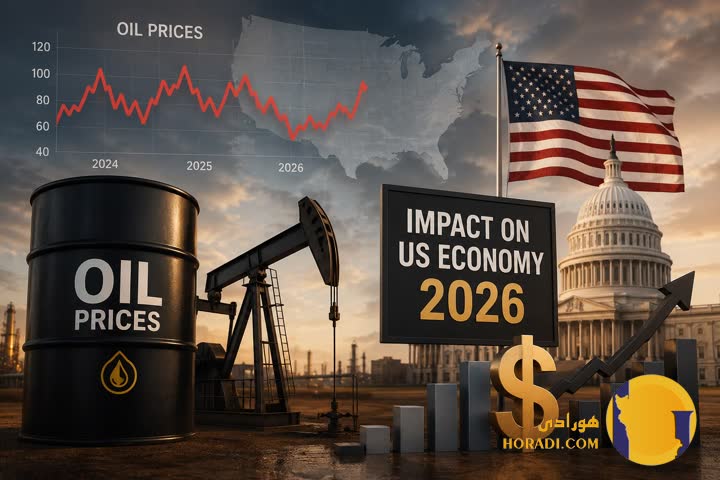
Oil Prices Impact on US Economy in 2026

Oil remains one of the most influential macroeconomic variables in the United States. Even in 2026, its price swings ripple through inflation, growth, and household budgets. The relationship is no longer linear, but it is still powerful enough to shift economic momentum.
Recent projections from the U.S. Energy Information Administration (EIA), Federal Reserve, and International Monetary Fund (IMF) highlight persistent volatility in global crude markets. Supply constraints, geopolitical instability, and energy transition policies are reshaping traditional price dynamics. The result is a more complex but still oil-sensitive US economy.
Unlike previous decades, demand is more elastic and efficiency has improved significantly. Still, gasoline, logistics, and petrochemicals remain tightly tied to crude benchmarks. That dependency keeps oil at the center of macroeconomic forecasting in 2026. Finance News
Key Takeaways
- Oil prices in 2026 remain a core driver of US inflation trends
- Consumer spending reacts quickly to changes in gasoline prices
- The Federal Reserve closely monitors energy shocks in rate decisions
- Domestic shale output softens but does not eliminate global exposure
- Energy transition reduces long-term sensitivity but not short-term volatility
Global Oil Market Outlook in 2026
Global crude markets in 2026 remain structurally tight despite expanding renewable capacity. OPEC+ production discipline continues to act as a price stabilizer. At the same time, demand from emerging Asia offsets stagnation in OECD consumption.
The EIA projects moderate demand growth, driven primarily by petrochemicals and aviation fuel recovery. Supply disruptions in key regions continue to create periodic price spikes. This keeps Brent crude trading in a relatively wide volatility band.
US shale production adds flexibility but faces higher breakeven costs than in the 2010s. Capital discipline among producers limits aggressive expansion even during price rallies. This structural shift reduces the speed of supply response.
Market sentiment in 2026 is highly reactive to geopolitical news cycles. Traders price in risk premiums more quickly than in previous decades. This amplifies short-term volatility even when fundamentals remain stable.
US Energy Demand and Consumption Trends
US energy consumption has plateaued but not declined significantly. Efficiency gains in vehicles and industry offset population and GDP growth. However, oil remains dominant in transportation energy demand.
Hybrid and electric vehicle adoption continues expanding rapidly in urban markets. Still, long-haul trucking and aviation rely heavily on liquid fuels. This creates a persistent baseline demand floor.
Seasonal demand swings remain a major pricing factor. Summer driving season and winter heating cycles still influence refinery utilization. These cycles create predictable short-term price volatility.
Energy substitution is gradual rather than disruptive. Infrastructure lock-in keeps oil relevant across multiple sectors. This slows the pace of full decoupling from crude markets.
Gasoline Prices and Consumer Spending
Gasoline remains the most visible transmission channel for oil price shocks. US households adjust discretionary spending quickly when pump prices rise. This makes fuel costs a direct consumer sentiment indicator.
In 2026, inflation-adjusted gasoline prices remain sensitive to crude benchmarks. Even small oil spikes translate into noticeable retail price changes. Consumers respond by reducing travel and shifting spending patterns.
Lower-income households experience disproportionate pressure from fuel inflation. Transportation costs consume a larger share of their disposable income. This amplifies inequality effects during oil price surges.
Retail and service sectors often see immediate demand slowdowns. Spending shifts toward essentials when fuel costs rise sharply. This creates short-lived but measurable GDP drag.
Inflation Channels and Monetary Policy
Oil prices remain a key input into headline inflation calculations. Energy shocks feed quickly into transportation and goods pricing. This creates upward pressure on CPI even in low-demand environments.
The Federal Reserve closely monitors energy volatility when setting interest rates. Temporary oil spikes are often excluded from core inflation measures. However, persistent increases can influence policy tightening cycles.
In 2026, inflation transmission is faster due to global supply chain integration. Logistics and shipping costs amplify crude price movements. This creates broader inflation spillovers beyond fuel alone.
Central banks now rely on forward-looking energy models. These models incorporate geopolitical risk and production elasticity. Policy decisions increasingly reflect energy market uncertainty.
Transportation and Logistics Costs
Transportation remains one of the most oil-dependent sectors in the US economy. Diesel prices directly affect freight, shipping, and last-mile delivery costs. This makes logistics highly sensitive to crude fluctuations.
Supply chain pricing adjusts rapidly to fuel cost changes. Retailers often pass through higher transportation costs within weeks. This accelerates inflation transmission into consumer goods.
Airlines face particularly volatile operating margins. Jet fuel prices are closely tied to global crude benchmarks. Even modest oil increases can significantly affect profitability.
In 2026, efficiency improvements partially offset cost pressures. Fleet modernization and route optimization reduce fuel intensity. However, full insulation from oil volatility remains unrealistic.
Manufacturing and Industrial Output
Manufacturing industries rely heavily on petrochemical inputs. Plastics, fertilizers, and synthetic materials depend on oil derivatives. This links industrial output directly to energy prices.
Higher oil prices increase production costs across multiple sectors. Firms often face margin compression or delayed investment decisions. This can slow industrial expansion during price spikes.
Some industries benefit from energy price inflation. Domestic refiners and integrated energy firms often see higher revenues. This creates uneven sectoral performance across the economy.
US manufacturing competitiveness is influenced by relative energy costs. Lower domestic energy prices historically supported reshoring trends. Volatility, however, introduces uncertainty into long-term planning.
Geopolitical Risks and Supply Shocks
Geopolitical instability remains a primary driver of oil price volatility. Conflicts in major producing regions can remove supply quickly. Markets react almost instantly to perceived disruptions.
Strategic reserves in the US act as a stabilizing buffer. The Strategic Petroleum Reserve can be deployed during acute shortages. However, its influence on long-term pricing is limited.
Sanctions and trade restrictions reshape global oil flows. These policies redirect supply chains rather than eliminate demand. This often increases transport costs and inefficiencies.
In 2026, geopolitical risk premiums are structurally embedded in pricing. Markets price uncertainty more aggressively than historical averages. This elevates baseline oil price levels.
Shale Production and Domestic Supply
US shale production remains a cornerstone of global oil balance. However, growth rates have slowed compared to the previous decade. Capital discipline and environmental constraints limit expansion.
Technological improvements have increased drilling efficiency. Operators extract more oil per well with lower operational costs. This partially offsets declining easy-to-access reserves.
Breakeven prices vary significantly across shale basins. Some regions remain profitable only at higher crude levels. This creates uneven domestic production dynamics.
Shale no longer acts as a rapid shock absorber. Its response to price changes is slower and more measured. This reduces its stabilizing effect on global markets.
Financial Markets and Energy Stocks
Energy prices strongly influence equity market performance. Oil majors experience revenue volatility tied to crude benchmarks. This affects broader index performance due to sector weighting.
In 2026, investors treat energy stocks as hybrid defensive-growth assets. Dividend yields remain attractive during high-price environments. However, volatility increases risk perception.
Commodity-linked ETFs and futures markets amplify price movements. Speculative positioning often exaggerates short-term trends. This increases intraday volatility in crude benchmarks.
Banking and credit markets also respond to oil cycles. Energy sector lending tightens during price downturns. This impacts capital availability for upstream investment.
Long-term Structural Transition to Renewables
The energy transition is gradually reshaping oil demand curves. Electric vehicles and renewable infrastructure reduce long-term consumption growth. However, transition speed varies significantly across sectors.
Oil demand is becoming more concentrated in hard-to-electrify industries. Aviation, petrochemicals, and shipping remain heavily dependent. This slows overall demand decline.
Investment in renewables reduces marginal oil sensitivity. But transitional overlap keeps both systems interdependent. This creates a hybrid energy economy.
In 2026, oil is still structurally relevant despite decarbonization progress. The transition dampens growth but does not eliminate volatility. Markets continue to price both old and new energy systems simultaneously.
Final Verdict
Oil prices in 2026 remain a central macroeconomic force in the United States. Their influence is less absolute than in past decades but still highly consequential. Inflation, consumer behavior, and industrial costs remain tightly linked to crude dynamics.
The US economy is more resilient due to diversification and efficiency gains. However, global supply shocks and geopolitical risks continue to transmit quickly. Oil is no longer the sole driver of economic cycles, but it is far from irrelevant. Oil Prices Impact on US Economy in 2026
FAQ
1. How do oil prices affect US inflation in 2026? They directly impact energy, transportation, and goods pricing. Spillover effects extend into core inflation through logistics costs.
2. Why are gasoline prices still important to the economy? They influence consumer spending behavior immediately. Higher prices reduce discretionary consumption across sectors.
3. Is the US still dependent on oil imports? Yes, but dependence is lower due to shale production. Global pricing still affects domestic markets significantly.
4. How does the Federal Reserve respond to oil shocks? It evaluates whether shocks are temporary or persistent. Policy adjustments depend on inflation persistence.
5. Will renewable energy reduce oil’s economic impact? Yes, but gradually and unevenly across sectors. Oil will remain important in hard-to-electrify industries for years.