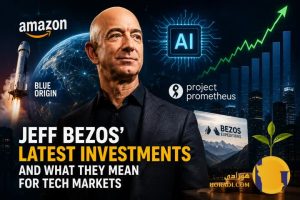
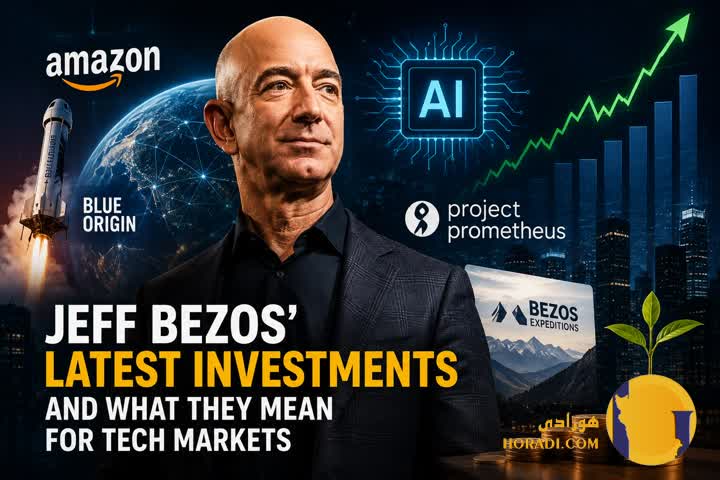
Jeff Bezos’ Latest Investments and What They Mean for Tech Markets

The investment moves of Jeff Bezos continue to shape conversations across Silicon Valley and Wall Street. While Amazon remains central to his legacy, Bezos has increasingly focused on sectors that could define the next decade of technological leadership.
His portfolio stretches well beyond e-commerce, touching artificial intelligence, aerospace, climate technology, healthcare, advanced manufacturing, and next-generation logistics. Investors often view these bets as early signals of where institutional capital may flow next.
Rather than chasing short-term market trends, Bezos consistently favors businesses capable of creating durable competitive advantages. That philosophy has helped make his investment activity one of the most closely watched indicators in modern technology investing. Market News
Key Takeaways
- Jeff Bezos continues expanding investments across AI, robotics, healthcare, aerospace, and climate technology.
- Long-term infrastructure remains a core theme throughout his investment strategy.
- Artificial intelligence has become one of the strongest areas attracting Bezos-backed capital.
- Private markets increasingly influence public technology valuations.
- Investors view Bezos’ portfolio as a leading indicator for future innovation cycles.
- Venture funding continues favoring companies solving large-scale industrial problems.
- Space commercialization remains a meaningful long-term opportunity.
- Enterprise software, automation, and cloud infrastructure continue benefiting from AI adoption.
Jeff Bezos Has Shifted Beyond Traditional Technology Investing
Many investors still associate Bezos almost exclusively with Amazon, yet his investment portfolio has evolved considerably. Today, his interests reflect broader structural changes taking place across global technology markets.
Instead of focusing only on consumer applications, Bezos increasingly supports companies building foundational technologies. Those investments often require patience but have the potential to reshape entire industries over many years.
Private venture investing allows Bezos to identify promising businesses before public markets recognize their value. That advantage creates opportunities unavailable to most retail investors following quarterly earnings cycles.
His recent investment activity demonstrates confidence in sectors where computing power, automation, advanced engineering, and scientific breakthroughs increasingly intersect with commercial demand.
Artificial Intelligence Has Become a Central Investment Theme
Artificial intelligence has rapidly transformed from a niche research field into the foundation of enterprise software and digital infrastructure. Bezos-backed investments increasingly reflect that transition.
Rather than investing only in chatbot developers, attention has shifted toward AI infrastructure, cloud computing, machine learning platforms, specialized chips, and enterprise productivity tools supporting large-scale deployment.
Growing demand for computing capacity continues driving investment throughout semiconductor manufacturing, data centers, networking equipment, and AI software ecosystems supporting commercial customers worldwide.
The broader lesson for investors is straightforward companies enabling AI adoption may ultimately prove more valuable than businesses simply using AI features as marketing tools.
Healthcare Innovation Continues Attracting Long-Term Capital
Healthcare remains one of the largest opportunities within Bezos’ broader investment philosophy. Aging populations, rising healthcare costs, and technological innovation create powerful long-term market drivers.
Digital diagnostics, personalized medicine, biotechnology, AI-assisted healthcare, and automation increasingly attract venture funding from investors seeking durable competitive advantages over traditional providers.
Many healthcare startups emphasize operational efficiency alongside patient outcomes. That combination aligns well with Bezos’ long-standing preference for scalable systems supported by software and automation.
Investors should recognize that healthcare innovation often develops gradually before accelerating rapidly once regulatory approval, reimbursement, and market adoption align successfully.
Robotics Is Moving From Warehouses Into Every Industry
Automation no longer belongs exclusively inside manufacturing facilities. Modern robotics increasingly supports logistics, agriculture, healthcare, construction, defense, and commercial services across developed economies.
Bezos has consistently demonstrated confidence in automation technologies capable of improving productivity while addressing labor shortages affecting numerous industries worldwide.
Machine vision, autonomous navigation, intelligent sensors, and AI-driven decision making have dramatically expanded what commercial robots can accomplish in real-world environments today.
As deployment costs decline, robotics companies may experience growth patterns similar to cloud computing providers during the previous technology expansion cycle.
Space Investments Continue Supporting Long-Term Commercial Growth
Commercial space exploration has matured into a serious investment category rather than remaining purely an engineering ambition. Satellite services, launch systems, communications, and national security all contribute to expanding demand.
Blue Origin continues pursuing reusable launch technologies while broader commercial partnerships strengthen the long-term economic outlook for space infrastructure and transportation.
Government contracts increasingly complement private-sector demand, creating more diversified revenue opportunities across aerospace suppliers and advanced engineering firms participating in commercial space markets.
Space investing remains capital intensive, yet investors increasingly recognize its strategic importance for telecommunications, Earth observation, scientific research, and future industrial development.
Climate Technology Is Becoming an Economic Opportunity
Climate innovation has evolved beyond environmental policy into a significant commercial opportunity attracting institutional investors worldwide. Energy efficiency and industrial modernization remain major priorities.
Investments supporting cleaner manufacturing, carbon reduction technologies, sustainable aviation, advanced batteries, and renewable infrastructure continue attracting substantial private funding across multiple industries.
Businesses capable of lowering operational costs while reducing emissions often generate stronger long-term economics than companies relying exclusively on regulatory incentives.
This investment theme reflects a broader market shift toward technologies solving practical business problems while supporting sustainability objectives simultaneously.
Infrastructure Investments Often Create Lasting Competitive Advantages
Infrastructure rarely generates headlines comparable to consumer technology, yet it frequently delivers stronger long-term returns through predictable demand and durable competitive positioning.
Modern infrastructure includes cloud platforms, fiber networks, logistics systems, data centers, semiconductor manufacturing, cybersecurity, and digital payment ecosystems supporting global commerce.
Bezos has repeatedly emphasized investing where customer demand compounds over decades rather than responding to temporary consumer enthusiasm or speculative market cycles.
Technology markets increasingly reward businesses owning critical infrastructure instead of companies depending entirely upon third-party platforms for growth and distribution.
Public Markets Often React to Private Investment Signals
Major venture investments frequently influence sentiment well before companies reach public exchanges. Institutional investors closely monitor high-profile portfolios searching for emerging technology themes.
When respected investors allocate significant capital toward specific industries, analysts often revisit valuation assumptions across publicly traded companies serving similar markets.
Market reactions rarely depend upon individual investments alone. Instead, cumulative funding trends help reveal where innovation ecosystems continue attracting talent, research, and commercial momentum.
Retail investors should avoid blindly copying billionaire portfolios while still recognizing valuable insights contained within long-term capital allocation decisions.
Investment Themes Influencing Markets
| Investment Theme | Market Impact |
|---|---|
| Artificial Intelligence | Higher enterprise software demand |
| Robotics | Increased industrial automation |
| Healthcare Technology | Growing digital health adoption |
| Space Economy | Commercial launch expansion |
| Climate Technology | Industrial modernization |
| Infrastructure | Long-term recurring revenue |
What Investors Should Learn From Bezos’ Strategy
Perhaps the most important lesson involves patience rather than stock selection. Bezos consistently prioritizes multi-year innovation cycles instead of quarterly market fluctuations.
His investment approach favors industries benefiting from irreversible technological change, making temporary volatility less significant over extended investment horizons.
Diversification also plays an important role. Rather than concentrating entirely within software, his portfolio spans multiple sectors benefiting from shared technological advances.
Investors building their own portfolios may benefit more from understanding these strategic principles than attempting to replicate specific venture investments individually.
Risks Investors Should Not Ignore
Even experienced investors accept that emerging technologies carry meaningful uncertainty despite attractive long-term potential. Many startups ultimately fail regardless of impressive funding rounds.
Artificial intelligence faces regulatory questions, cybersecurity challenges, infrastructure constraints, and rapidly evolving competitive dynamics affecting future profitability across technology markets.
Space commercialization remains dependent upon engineering execution, launch economics, government partnerships, and sustained customer demand over many years before achieving full maturity.
Successful investing requires balancing optimism about innovation with disciplined risk management, portfolio diversification, and realistic expectations regarding technological adoption timelines.
Why Bezos’ Portfolio Matters More Than Individual Investments
The significance of Bezos’ investment activity extends beyond any single startup or funding announcement. His portfolio illustrates broader economic shifts reshaping global technology leadership.
Viewed collectively, these investments reveal consistent confidence in automation, artificial intelligence, scientific research, advanced infrastructure, and long-term industrial transformation rather than short-lived consumer trends.
Technology investors increasingly study capital allocation patterns because they often highlight emerging industries before mainstream financial markets fully recognize their commercial potential.
That perspective explains why Bezos remains one of the world’s most influential technology investors despite stepping away from Amazon’s day-to-day executive leadership.
High-Authority Sources
- U.S. Securities and Exchange Commission (SEC) – Public company filings and regulatory disclosures.
- Amazon Investor Relations – Corporate announcements, shareholder communications, and executive updates.
- Bezos Expeditions – Public information regarding Jeff Bezos’ investment activities and portfolio companies.
Final Verdict
Jeff Bezos’ latest investments reinforce a consistent long-term philosophy centered on transformative technologies rather than short-term market excitement. Artificial intelligence, robotics, healthcare innovation, climate technology, commercial space, and digital infrastructure all represent sectors positioned to benefit from structural economic change throughout the coming decade.
For investors, the greatest takeaway is not copying individual investments but recognizing recurring themes. Capital continues flowing toward businesses building the foundational technologies powering tomorrow’s economy, suggesting that infrastructure, automation, and scientific innovation will remain among the strongest drivers of technology markets through the remainder of the decade.
FAQ
1. What are Jeff Bezos’ biggest investment themes in 2026?
Artificial intelligence, robotics, healthcare technology, commercial space, climate innovation, digital infrastructure, and advanced logistics remain the primary focus areas across Bezos’ investment portfolio.
2. Why do investors closely watch Jeff Bezos’ investments?
His long-term investment track record often identifies transformative industries years before they become mainstream, making his portfolio an important indicator of future technology trends.
3. Does Jeff Bezos invest mainly through Amazon?
No. While Amazon remains central to his career, many recent investments are made through Bezos Expeditions and other private investment vehicles independent of Amazon.
4. How does Bezos’ investment strategy affect technology markets?
Large investments from influential technology investors can increase market confidence, attract additional venture funding, accelerate innovation, and influence valuations across related public companies.
5. Should individual investors follow Jeff Bezos’ portfolio?
Investors may benefit more from understanding the long-term themes behind Bezos’ strategy than attempting to duplicate private investments that are often unavailable to public market participants.